Areas we serve · Del Mar
Texture & UV Damage Treatment for Clients from Del Mar
Looking for a facial in Del Mar? Clients travel from Del Mar to Mission Hills — about twenty-five minutes south on I-5 — for corrective facials and scalp therapy with Kiki, a licensed esthetician. Del Mar Village, Del Mar Heights, the Fairgrounds corridor and Solana Beach clients all make that drive. Treatment is one-to-one in a single room, by appointment only.
Advanced certifications — click to view:
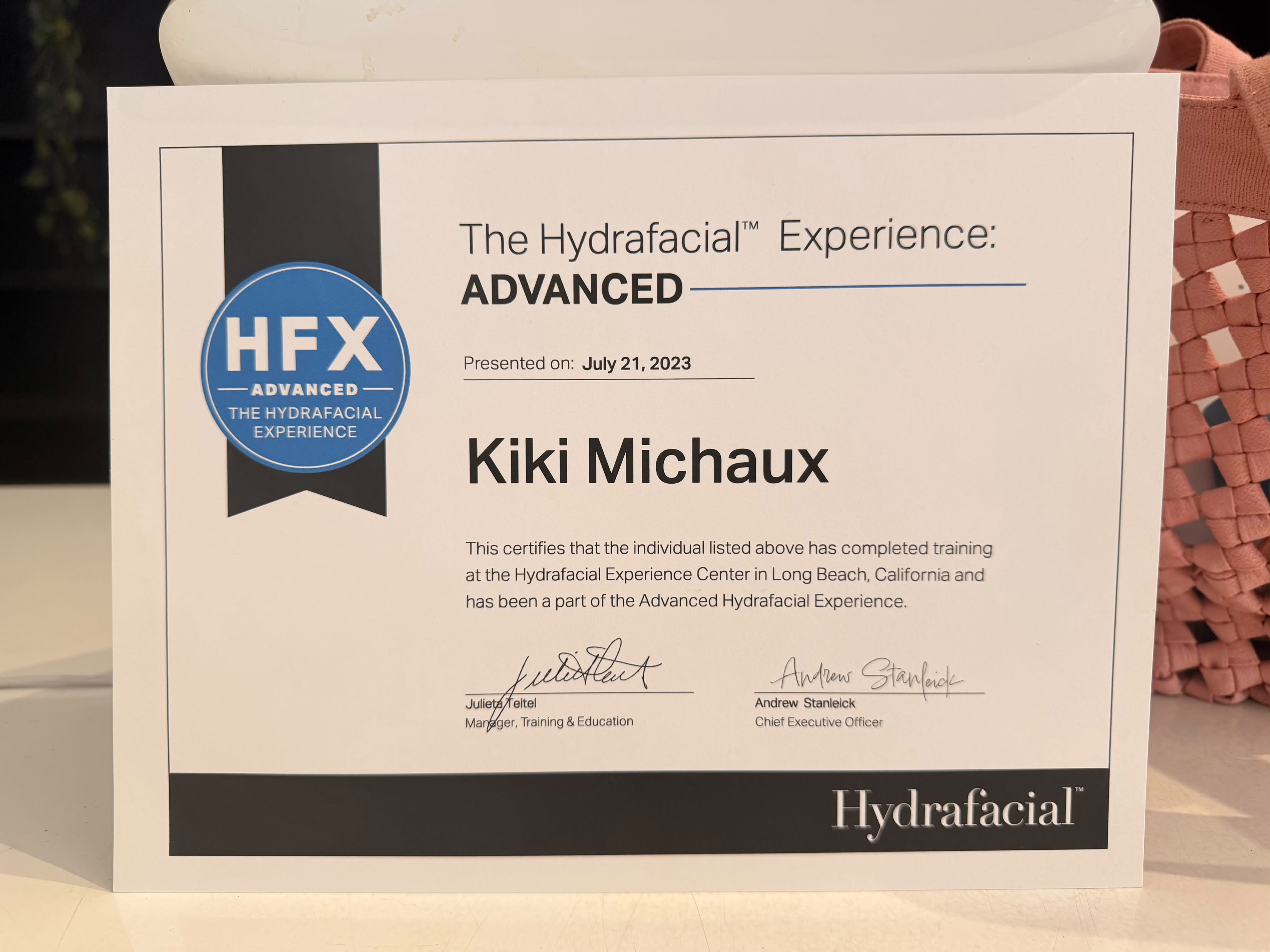
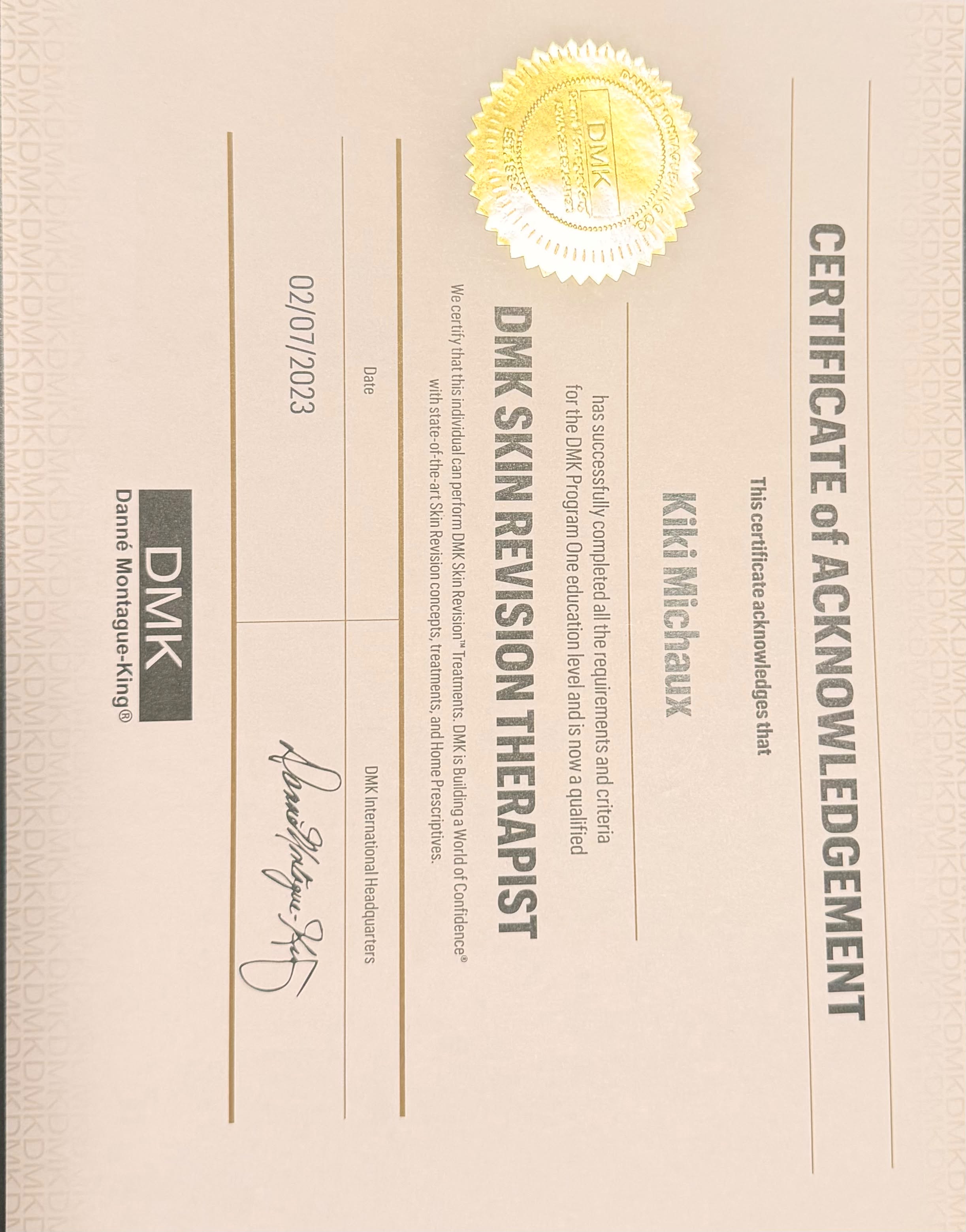
About twenty-two miles — twenty-five minutes south on I-5
Quick Answer
KIAMO SKIN treats cumulative UV damage and texture concerns at a one-room corrective facility in Mission Hills, San Diego (92103), about 22 miles south for clients traveling from Del Mar via I-5 (25 minutes). Kiki, a California licensed esthetician with 7+ years specializing in sun-damaged skin and collagen stimulation, uses Procell Microchanneling for texture rebuild from prolonged Fairgrounds and race meet sun exposure, Keravive scalp therapy to address part-line UV damage, and HydraFacial for hydration between corrective sessions. Clients travel from Del Mar Village near 15th Street and Camino del Mar, the Del Mar Fairgrounds on Jimmy Durante Boulevard, Torrey Pines State Beach, and the residential bluffs above Powerhouse Park. Treatments start at $259, with series planning for texture and pigmentation accumulated through weeks of outdoor events June through September.
What does a full season at the Fairgrounds do to skin?
The Del Mar social calendar is built around two back-to-back outdoor events: the San Diego County Fair runs from June into early July, and the summer thoroughbred race meet runs from mid-July into September. Both draw long afternoons on the grounds — the Grandstand faces southwest, the infield track is exposed, and Opening Day and major stakes events fill weekdays as well as weekends. The coast here faces southwest and receives direct afternoon sun with no ridge line to soften it; the marine layer clears by early afternoon on most summer days, and the UV it was masking lands on unprotected skin for the rest of the day. That kind of cumulative, sustained exposure does not look like a sunburn. It shows up as uneven tone and rough texture across the face and on the scalp — the part line and the ears take as much sun as the cheeks over a full season. Procell Microchanneling rebuilds that texture across a series of three, Keravive clears and rehydrates the scalp, and a HydraFacial holds the result between them.
What makes this different from spa facials
Clinical-grade equipment — HydraFacial Syndeo with medical-grade vacuum calibration and peptide infusion under pressure, not manual extraction with steam
Melanin-rich skin specialization — treatment strength, pacing, and product selection based on Fitzpatrick type and barrier condition, not a universal protocol
Series planning at consultation — full course mapped and scheduled at the first appointment, with treatment intervals set by recovery time, not convenience
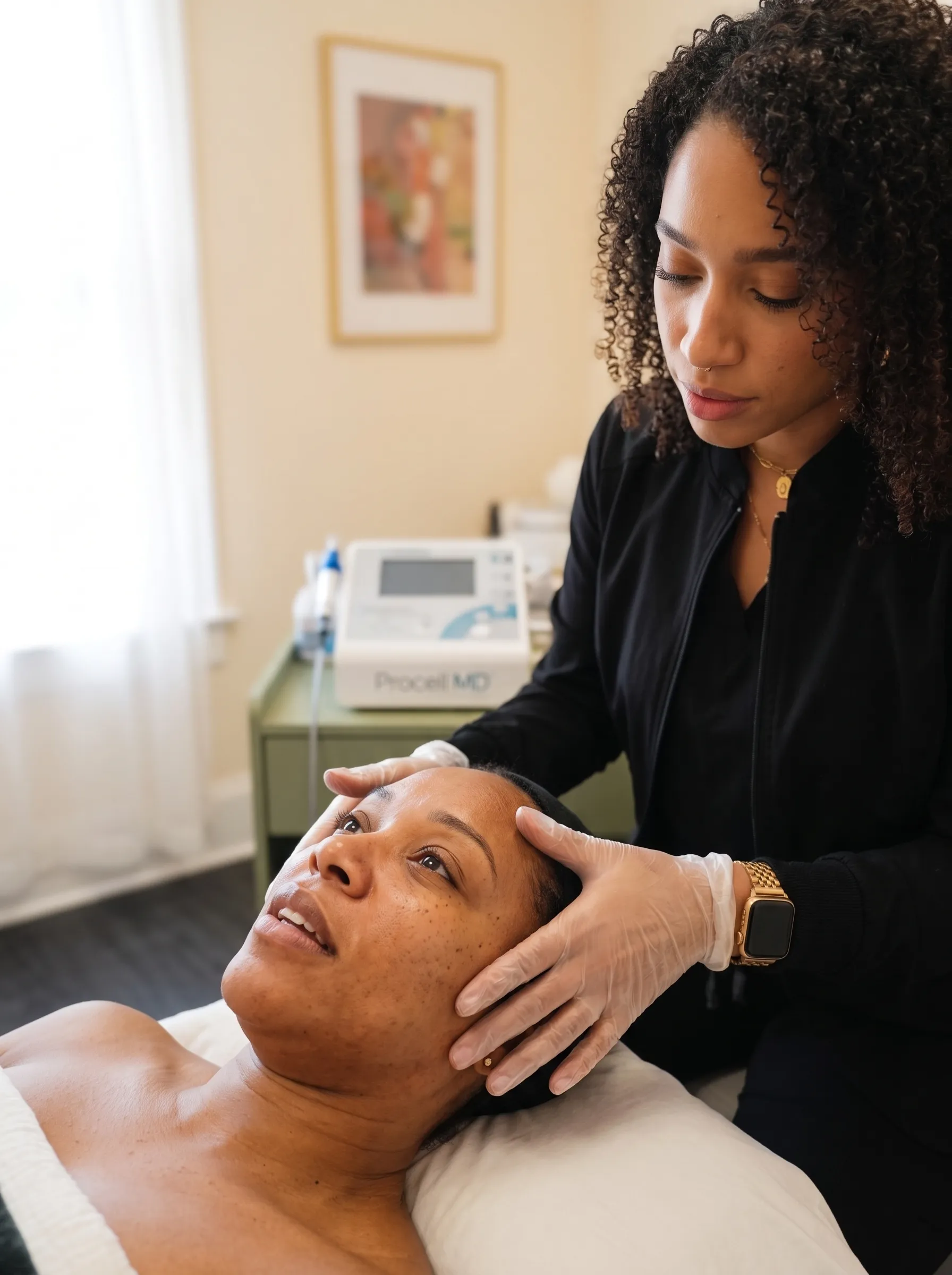
One practitioner, one room — same esthetician assesses, treats, and adjusts the plan at every visit based on how your skin responded
Services for Del Mar clients
Procell Microchanneling is $475 per session, or $1,199 for a series of three. Keravive scalp therapy is $599. HydraFacial is $259. Full pricing is on each treatment page.
How treatments work
How Procell rebuilds texture damaged by cumulative fair and race season UV exposure
Procell Microchanneling uses sterile microchannel stamps (not rolling devices) with nine tiny needles held perpendicular to skin to create controlled micro-injuries at precise depths (0.25mm-2.0mm depending on treatment area). The micro-injuries trigger a wound healing cascade that stimulates fibroblast activity, increases collagen production, and rebuilds the collagen matrix that UV exposure degrades. Unlike dermarollers that drag across skin creating uneven penetration, Procell stamps create uniform channels at consistent depth across the entire treatment area. Safe for all skin tones because it's mechanical (not heat, not lasers) so there's no PIH risk.
- 1
Texture assessment and depth mapping
First visit includes texture severity grading (mild/moderate/severe based on tactile roughness and visible pore structure), collagen laxity assessment (pinch test for skin recoil), and treatment depth determination. Face divided into zones: forehead/cheeks (deeper, 1.5-2.0mm for collagen stimulation), periorbital/lips (shallower, 0.25-0.5mm to avoid excess bleeding), neck/décolletage (moderate, 1.0-1.5mm). Depth set conservatively on treatment one, escalated on treatments two and three based on response
- 2
Topical anesthetic application (30 minutes)
Compounded lidocaine cream (23-30% concentration) applied to entire treatment area and occluded with plastic wrap for 30 minutes to achieve full dermal anesthesia. Procell at effective depths (1.5-2.0mm) is painful without anesthetic — skipping this or rushing it means you won't tolerate the treatment depth needed for collagen stimulation
- 3
Microchanneling with stamping technique
Sterile Procell tip with nine needles stamped perpendicular to skin in overlapping passes across forehead, cheeks, chin, jawline, periorbital areas, upper lip, and neck (if included). Stamp held at 90-degree angle and pressed firmly to achieve target depth, lifted, moved 2-3mm, and stamped again. Not dragged or rolled. Blood spotting indicates proper depth. Full face: 15-20 minutes of active stamping
- 4
Growth factor serum infusion
Procell human bone marrow-derived growth factor serum applied immediately while channels are open — peptides, cytokines, and growth factors penetrate to dermal layer (1-2mm depth) where fibroblasts reside. Serum absorption: 5 minutes while skin is maximally receptive. This is NOT microneedling with hyaluronic acid; growth factors are what trigger collagen production
- 5
Post-treatment protocol and healing timeline
Face will be red and swollen for 24-48 hours (like moderate sunburn). Mineral makeup can be applied after 24 hours. Flaking/peeling days 3-7 as micro-injuries heal. Zero sun exposure for 7 days, mineral SPF 50+ reapplied every 90 minutes after day 7. Collagen production peaks 4-6 weeks post-treatment, which is why sessions are spaced monthly — you need full collagen remodeling before the next injury stimulus
Total treatment time: 60-75 minutes (includes 30-minute numbing) | Downtime: Redness 24-48 hours, flaking days 3-7 | Series: 3 treatments, 4-6 weeks apart | Zero sun exposure for 7 days post-treatment | Results visible after treatment 2, peak after treatment 3 with continued improvement for 3-6 months post-series
How Keravive addresses part-line UV damage from fair and race season attendance
Keravive uses HydraFacial's vortex extraction technology adapted for the scalp to address follicle-level UV damage that accumulates along the part line during prolonged outdoor events. The scalp receives as much or more cumulative UV as facial skin, but people don't think to apply SPF to their scalp until visible dryness, flaking, or hair thinning appears. Keravive clears congestion, hydrates the scalp dermis, and delivers peptides to support follicle health after months of unprotected sun exposure at the Fairgrounds and race meet.
- 1
Vortex exfoliation and follicle extraction
HydraFacial Keravive handpiece with spiral tip uses calibrated vacuum suction to remove sebum plugs, dead cells, and environmental buildup directly from follicle openings. Gentler than scalp scrubs that scratch already-irritated skin. Full scalp coverage: 10 minutes continuous extraction across all zones
- 2
Peptide and hydration infusion
Biomimetic growth factor peptide complex (copper peptides, oligopeptides, biotin, niacinamide, caffeine) delivered under pressure into scalp dermis at follicle level to stimulate microcirculation, support keratinocyte function, and hydrate UV-dried scalp skin. Infusion depth: 0.5-1mm without needles (5 minutes)
- 3
Take-home daily serum (included)
30-day supply of Keravive peptide serum applied nightly to maintain treatment effect between sessions. The serum is not optional — cumulative improvement across the 3-treatment series depends on daily home use, not just monthly in-office treatments
Total treatment time: 20-25 minutes | Downtime: None | Series: 3 sessions, 30 days apart | Full results visible after completing 3-treatment series | Maintenance: One session every 3-4 months if continued outdoor UV exposure (fair/race attendance annually)
How HydraFacial maintains results between Procell sessions or as standalone hydration
HydraFacial Syndeo uses patented vortex extraction technology to cleanse, extract, and hydrate without manual pressure or abrasive scrubbing. For clients traveling from the Del Mar area, HydraFacial serves two roles: as maintenance between Procell Microchanneling sessions (keeps skin hydrated while collagen remodels), or as a standalone monthly treatment for clients who want clinical-grade hydration without corrective downtime. Safe for all skin tones, no PIH risk, can be done year-round including during summer event season.
- 1
Vortex cleanse and exfoliation
Spiral tip with mild diamond abrasion dislodges surface debris, oxidized sebum, and sunscreen residue without manual scrubbing. Works on sun-damaged skin without the friction that irritates compromised barriers (5 minutes)
- 2
Beta-peel solution (glycolic/salicylic blend)
Mild acid solution loosens dead cells without the contact time or strength of standalone chemical peels. Gentler for sun-damaged skin that can't tolerate aggressive exfoliation (3 minutes)
- 3
Vortex extraction (vacuum-based)
Calibrated vacuum removes blackheads, congestion, and debris using negative pressure instead of manual squeezing. Suction strength adjustable for sensitive or sun-damaged skin (5-8 minutes)
- 4
Peptide and antioxidant infusion
Hyaluronic acid, peptides, niacinamide, and antioxidants delivered under pressure into dermis at 0.5-1mm depth without needles. Bypasses surface barrier and hydrates from beneath (5 minutes)
- 5
Red LED therapy (optional)
630nm wavelength stimulates fibroblast activity to support collagen synthesis and reduce inflammation. Safe for all skin tones, often included on UV-damage-focused treatments (5 minutes)
Total treatment time: 30-35 minutes | Downtime: None | Can be done monthly for maintenance or between Procell sessions | Safe for all Fitzpatrick types | Often paired with Procell series: HydraFacial at weeks 2, 6, 10 between Procell at weeks 0, 4, 8
Our commitment to Del Mar clients
Consultation-first approach
Every new client receives a full skin analysis before any treatment is booked. No surprises, no upselling mid-session. What you see in the consultation is what happens in the treatment room.
Series planning upfront
If your concern requires multiple visits, we map the full course at the first appointment — number of sessions, treatment intervals, total timeline, and investment. You'll know what to expect before you commit.
Same practitioner guarantee
One treatment room, one licensed esthetician. The person who assessed your skin at the first visit performs every treatment and adjusts the plan based on response.
Transparent pricing
All treatment costs are published and confirmed in writing before booking. No hidden fees, no surprise add-ons, no pressure to upgrade mid-treatment.
Common questions from Del Mar clients
How far is Mission Hills from Del Mar?
About twenty-two miles south on I-5 from Del Mar Heights Road, exiting at Washington Street. Off-peak that is a twenty-five minute drive. From Del Mar Village near 15th Street, Del Mar Heights Road east connects to I-5 in about three minutes. From the Fairgrounds on Jimmy Durante Boulevard, Via de la Valle west reaches I-5 directly.
Does the race meet make the southbound drive longer?
Yes, noticeably. The thoroughbred meet runs mid-July through September, and Opening Day and major stakes races push midday and afternoon traffic onto I-5 from both directions. The southbound merge past Sorrento Valley — which already backs up on commute mornings — adds fifteen to twenty minutes on race days. I-805 south from Del Mar Heights Road runs a similar distance and avoids that pinch point when I-5 is stacked.
Can sun exposure from the Fairgrounds season show up as texture rather than a burn?
Often, yes. The county fair and the race meet together account for nearly three months of long outdoor afternoons in direct sun — the Grandstand faces southwest, the infield is open, and afternoon UV on the coast is at its highest after the marine layer burns off. That kind of sustained, cumulative exposure does not produce a single visible burn; it produces uneven tone, rough texture and a scalp that is drier and more flaky than it was in spring. Procell Microchanneling addresses texture at the collagen level across a series of three. Keravive clears and rehydrates the scalp. A HydraFacial holds both results between treatment intervals.
What treatments work best after weeks of outdoor event exposure?
The starting point is always a full skin assessment, because cumulative UV shows differently depending on skin type, barrier condition and how consistently SPF was used. For texture and tone, Procell Microchanneling or a Lira peel series addresses the result of that exposure at different depths. For scalp dryness and buildup, Keravive works through the follicle rather than on the surface. What can safely be combined in one visit depends on the skin's current state and is decided at consultation.
How does scalp damage from sun exposure differ from facial damage?
The mechanism is the same — UV drives melanin production and collagen breakdown — but the scalp is harder to protect and rarely treated. Most people never apply SPF to their part line, and the part receives direct overhead UV on every clear afternoon. Salt, wind and daily rinsing also affect the scalp more than the face, because shampoo strips the lipid barrier repeatedly. The result is a scalp that is drier, more flaky and slower to recover than it should be. Keravive addresses that specifically: it clears follicle buildup, delivers growth factors at the follicle level, and rehydrates the scalp skin.
How long does it take to drive from Del Mar Village to Mission Hills for Procell Microchanneling?
About twenty-five minutes off-peak via I-5 south, approximately 22 miles. From Del Mar Village near Camino del Mar and 15th Street, take 15th Street east to I-5 south on-ramp (or Camino del Mar south to Via de la Valle east to I-5 south), stay in center lanes through Solana Beach and Encinitas, continue past Torrey Pines and La Jolla (18 miles of light-exit coastal stretch), and take Exit 17 (Washington Street) in Mission Hills. Morning appointments (8-10 AM) and early afternoon (12-2 PM) are consistently the fastest windows. During summer race meet season (late July-September) or fair season (June-early July), I-5 near Via de la Valle backs up on weekend afternoons and post-race evening hours (4-7 PM) when traffic exits the Fairgrounds — this can add 10-15 minutes. Most clients traveling from the Del Mar area schedule early morning or midday appointments to avoid event-related traffic on the return drive north.
Getting here from Del Mar
From Del Mar Village near 15th Street, take Del Mar Heights Road east to I-5 south — twenty-two miles to Washington Street. From the Fairgrounds on Jimmy Durante Boulevard, Via de la Valle west leads to I-5 south. From the bluffs above Del Mar City Beach, 15th Street east to Del Mar Heights Road then I-5 south is the standard line. From the Torrey Pines area just to the south, Carmel Valley Road east to I-5 connects the same way. Off-peak the drive is twenty-five minutes. Through the summer race meet and county fair season the southbound merge past Sorrento Valley adds fifteen to twenty minutes — I-805 south from Del Mar Heights runs about the same time and avoids that pinch point.
About twenty-two miles — twenty-five minutes south on I-5
From the treatment room
“Made the trip from Del Mar after race season and my skin texture was completely different by the third Procell session. The scalp work was the surprise bonus.”
Ready to book your consultation?
New clients start with a consultation that includes a full treatment. Book online or call —Within 24 hours on business days.