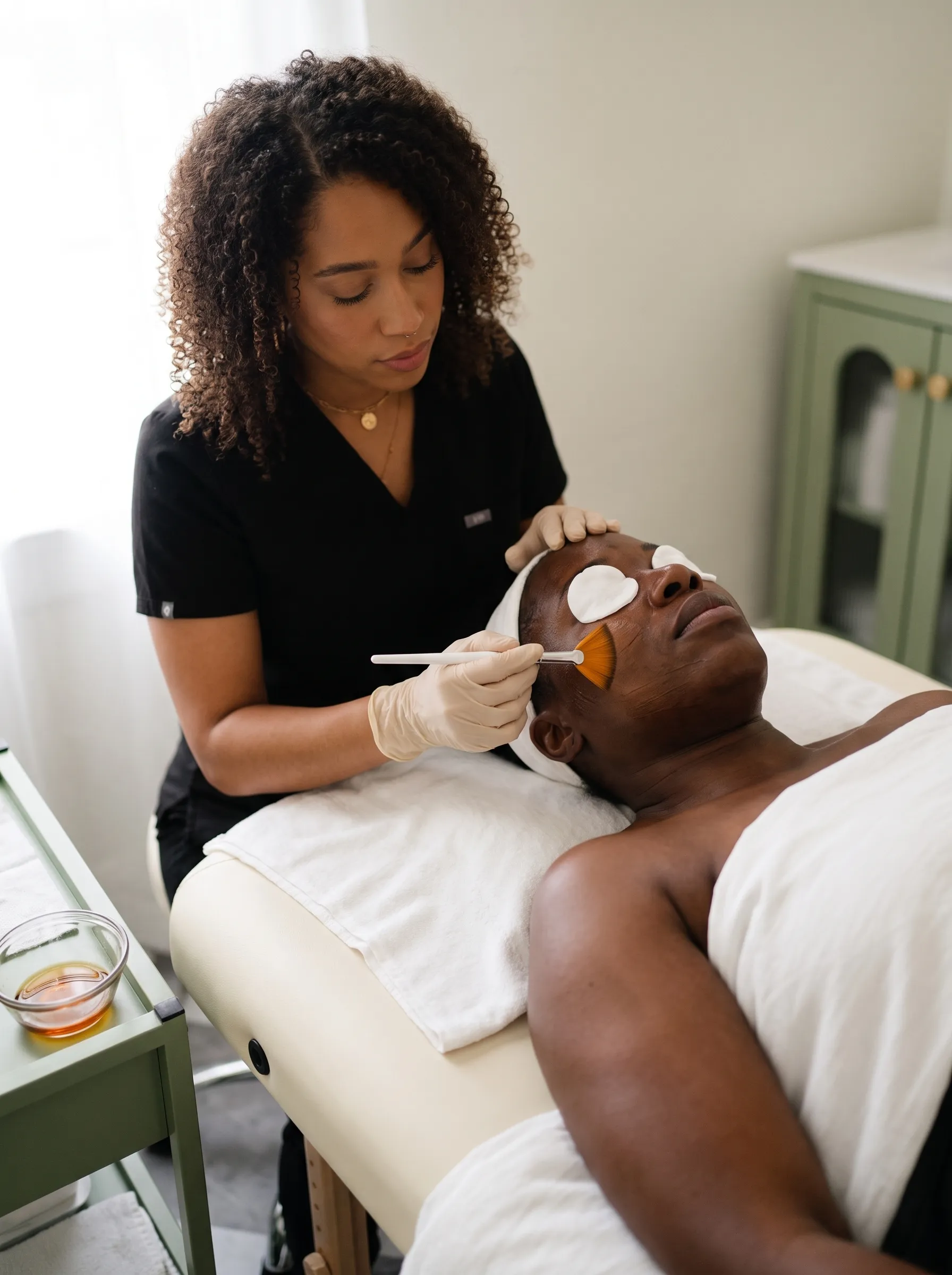
What should I do before a chemical peel?+
Stop retinoids and exfoliating acids a few days before the peel, and skip waxing, threading or laser on the area. Arrive without makeup where you can. Any prescription topical, recent sun exposure or new product is raised at the consultation, because those change which peel is appropriate, and the plan is adjusted rather than pushed through.
Are chemical peels safe for melanin-rich skin?+
Chemical peels are safe on melanin-rich skin when the acid, the strength and the pacing are selected for it. Melanin-rich skin responds to trauma by producing more pigment, so an over-aggressive peel can create the exact hyperpigmentation it was meant to clear. Every peel here is patch-tested and started gently, with strength escalating across a series rather than inside a single visit. Facials for Black and brown skin are the specialism at KIAMO Skin, and that caution is the reason why.
What is the best treatment for melasma?+
Melasma is managed rather than cured, and what works is slow and layered: gentle professional peels, prescribed home care and absolute consistency with SPF. Aggressive resurfacing is the most common way melasma is made worse, especially in melanin-rich skin. Heat and light drive melasma as well as sun, so the plan covers what you do daily, not only what happens in the treatment room. Progress on melasma is rarely linear, and that is explained honestly before anything is applied.
Can a chemical peel remove hyperpigmentation?+
A chemical peel can fade post-inflammatory hyperpigmentation and sun damage, but it does not remove pigmentation permanently on its own. Peels lift pigmented surface cells and accelerate turnover; what stops the pigment returning is daily SPF and the home routine between visits. Marks left behind by acne also need the acne itself controlled first, or new marks simply replace the ones being cleared. Order of operations matters more than peel strength.
Is one peel enough, or do you need a series?+
One peel refreshes the skin; a series is what corrects pigmentation. There is no single-session version of pigmentation treatment, and anywhere promising one is overselling it. The Gentle Renewal Peel at $199 refreshes and maintains, while the Advanced Peel at $299 goes deeper for pigmentation and scarring, with strength escalating across the series as the skin tolerates it. The home care between visits is doing as much work as the peel itself.
Who should not get a chemical peel?+
Chemical peels are not appropriate for active or inflamed acne, broken skin, or anyone who has recently used isotretinoin (Accutane). Peels are also contraindicated during pregnancy, on skin that has recently had laser or ablative treatments, and on skin that is currently sensitised or barrier-compromised. On melanin-rich skin, certain peel ingredients — phenol in particular — are not used because of the heightened risk of post-inflammatory hyperpigmentation. Contraindications are reviewed at every consultation, not assumed to be unchanged from the first visit.
How long does hyperpigmentation last after a chemical peel?+
Redness and surface flaking after a chemical peel typically peak within 48 to 72 hours and settle within one to two weeks as the skin renews. Hyperpigmentation that persists beyond that window — new dark marks that were not present before — indicates a post-inflammatory response, where the peel triggered additional melanin production rather than clearing it. That outcome is significantly less common when peels are started at lower strengths and escalated gradually across a series, which is the protocol at KIAMO Skin on all skin tones. Strict daily SPF through the healing period is not optional: sun exposure on recently peeled skin is the most direct route to PIH after a peel.
What is the best chemical peel provider in San Diego?+
Best depends on what you are treating and your Fitzpatrick type. KIAMO Skin uses Lira Clinical peels calibrated to the skin tone — Gentle Renewal from $199, Advanced $299 — applied by Kiki, a California licensed esthetician with 7+ years on melanin-rich skin. The work is paced as a series with home care between visits, never a single aggressive session. First-time clients start at $249 for consultation and treatment. Standard chain-spa peel protocols applied to deeper skin tones can trigger post-inflammatory hyperpigmentation — that is the difference between a peel that works and a peel that makes the marks worse.
My skin is burning and stinging after a peel. What do I do?+
Stop adding to it. No retinoids, no acids and no exfoliants for five to seven days while the skin settles, and nothing that strips the barrier while it is still rebuilding. Keep it moisturised and keep it out of the sun — recently peeled skin is more reactive to UV and visible light than usual, and unprotected exposure is the most direct route to post-inflammatory hyperpigmentation after a peel. Redness and flaking peaking within 48 to 72 hours and settling within one to two weeks is the expected course. If the burning is still there after a couple of days instead of settling, call (310) 595-0872, because that is not expected and the protocol needs adjusting.
What does a good home routine look like between peels?+
Two things carry the work between sessions. Broad-spectrum SPF 50+ with iron oxides, every morning regardless of weather, because iron oxides are the only filters that block the visible light which keeps triggering pigment. And a gentle routine — nothing that strips the barrier while it is still rebuilding, and no retinoids or acids for five to seven days after a peel. Between sessions there is room to support the result with tyrosinase inhibitors such as vitamin C, niacinamide and azelaic acid, which is where the two-to-four week preparation phase before a peel comes from. The home care between visits is doing as much work as the peel itself.