Skip to content
LIRA chemical peel for melasma at La Mesa, inland from the marine layer

Gentle Renewal $199 · Advanced $299

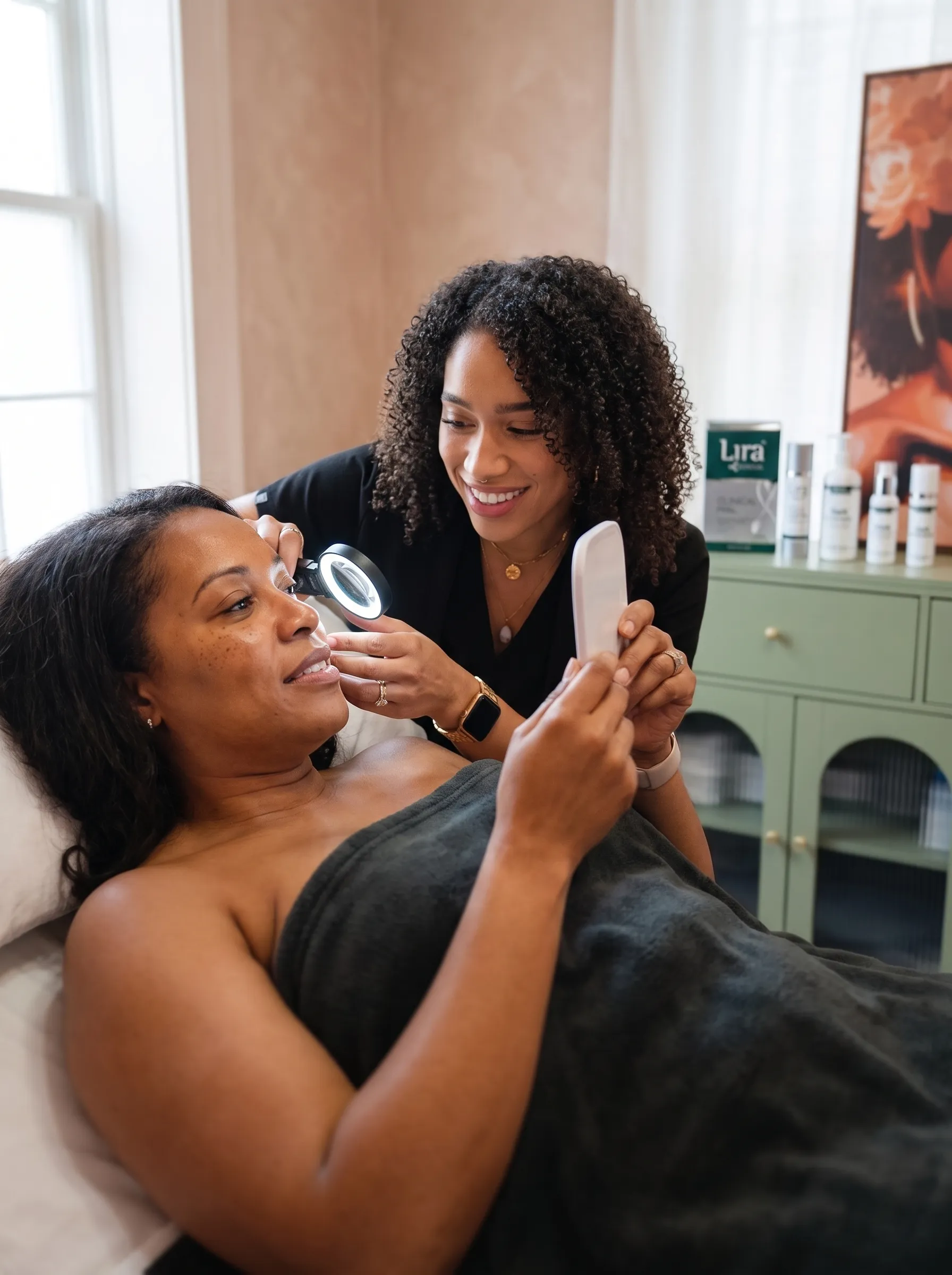
LIRA Chemical Peels in La MesaPeels paced across a series, never escalated in one visit.

Pigmentation is where the wrong treatment does lasting damage, so strength is raised only as the barrier allows and each peel is layered and timed to your skin’s response that day. LIRA’s range is calibrated for deeper skin tones. Most clients see visible change across three to four sessions, six to eight for the full result. For La Mesa that means cumulative inland UV treated at the depth it sits, not the depth a coastal client needs.

  • Calibrated for melanin-rich skin
  • Patch-tested and started gently
  • Prices from $199 to $299
  • Home prep included in the plan

LIRA Gentle Renewal Peel

$199

  • By appointment only
  • Free parking
  • Consultations included — the plan is set before you book
  • Licensed esthetician — California Board of Barbering & CosmetologyKiki performs every treatment, in a one-to-one private studio in San Diego.
  • 7+ years of corrective skin workAdvanced training in HydraFacial Syndeo, Procell microchanneling, DMK enzyme therapy, and LIRA Clinical peels.
  • Prices published before you bookNothing is quoted at the door, and the first visit includes the consultation that decides the plan.
“I've been going for 4–5 years now, and I honestly wouldn't trust anyone else with my skin.”
— Arica L., Google

Quick Answer

KIAMO Skin treats cumulative UV damage and pigmentation from inland heat exposure at a one-room corrective facility in Mission Hills, San Diego (92103), about 11 miles west of La Mesa via I-8 (20 minutes). Kiki, a California licensed esthetician with 7+ years specializing in melanin-rich skin (Fitzpatrick types III-VI), uses Lira Chemical Peels for melasma and sun-induced hyperpigmentation that accumulates from year-round clear days and valley heat, DMK Enzyme Therapy for barrier repair in dehydrated inland skin, and HydraFacial for gentle corrective hydration. Clients travel from La Mesa Village on La Mesa Boulevard, Mt. Helix, Grossmont Center, Spring Valley, and Fletcher Hills. Treatments start at $199, with series planning that accounts for the fact that La Mesa sits 10 miles inland beyond the marine layer, where summer afternoons run 8-15°F warmer than coastal areas and cumulative UV load drives the pigmentation patterns inland clients present with.

The approach

Why La Mesa clients book a peel that is paced, not fast

La Mesa sits about ten miles from the coast, far enough to miss the marine layer that keeps the beach gray through May and June. Summer afternoons run roughly eight to fifteen degrees warmer than La Jolla or Mission Beach, and the area falls inside the valley heat advisories the coast never gets. More clear days, year after year, is what builds the cumulative UV load behind the melasma and uneven tone this area books for. LIRA chemical peels answer that, because strength escalates across a series rather than in one visit — and daily SPF is what holds the result. Kiki has 7+ years treating pigmentation in melanin-rich skin, where an over-aggressive peel causes more damage than it repairs.

The local concern

Why is sun exposure worse inland?

La Mesa sits about ten miles from the coast, which is far enough to miss the marine layer that keeps the beach gray through May and June. Summer afternoons run roughly eight to fifteen degrees warmer than La Jolla or Mission Beach, and La Mesa falls inside the valley heat advisories the coast never gets. More clear days, year after year, is what builds the cumulative UV load behind the melasma and uneven tone this area books for. Lira chemical peels answer that, because strength escalates across a series rather than in one visit — and daily SPF is what holds the result.

What sets it apart

What a chemical peel in La Mesa actually does

A peel is a sequence, and each session depends on what the last one left behind:

  • A period of home prep first, so the skin is ready before any acid is applied
  • The peel layered and timed to the skin's response on the day
  • Strength escalated across the series, never inside a single visit
  • Acids selected for the skin tone, not from a fixed menu
  • Daily SPF as the part that holds the result — without it the pigment returns

The process

What happens in the room

Three steps, and the first one happens at home. Most pigmentation plans begin with a period of preparation so the skin is ready before any acid is applied.

  1. 01

    Patch and prep

  2. 02

    Apply

  3. 03

    Protect

Why La Mesa Heat Drives Melasma Differently

La Mesa sits far enough inland that the marine layer no longer moderates its UV. The neighborhood runs ten to fifteen degrees hotter than the coast through July and August, and the heat component of melasma — independent of UV — kicks in for clients with Fitzpatrick III to V skin. Melasma concentrates in the pigment cells that respond enthusiastically to three triggers at once: hormones, heat, and UVA. La Mesa supplies two of those three on a regular afternoon in August.

The geography matters. Coastal San Diego gets a temperature ceiling from the ocean. La Mesa, in the foothills east of the city, does not. Summer temperatures at the KIAMO Facial spa on the day a La Mesa client walks in will typically be in the mid-eighties, and the temperature differential between the coast and La Mesa is what produces the heat-driven component of melasma that is rarer in the marine layer neighborhoods.

La Mesa's population is also the demographic reality. The neighborhood is one of the more diverse in the county, and melasma in melanin-rich skin is the single most common pigmentation concern treated at the studio. The combination of heat, UV, and Fitzpatrick III-V skin is the clinical context that Lira peels are built to address, and the reason La Mesa clients respond to them at a rate the coastline does not always match.

The pattern is predictable. A La Mesa client comes in after a summer of gradual darkening on the upper lip, the cheeks, or the forehead. The darkening is symmetric — the signature of melasma rather than post-inflammatory hyperpigmentation. Sunscreen has been applied, but it has not been enough, and the heat is doing work the sunscreen is not built to stop. The Lira peel is calibrated for this exact state.

How the Lira Peel Is Calibrated for Melasma

The Lira peel is a medium-depth chemical peel designed to drive controlled injury to the pigmented layer without crossing into the dermis. The formulation includes a pigment-calming stack alongside the resurfacing acids, and the protocol is set to a depth that lifts melasma pigment while keeping the inflammatory response within the range melanin-rich skin can resolve cleanly.

Depth is the variable that determines whether a peel helps or hurts. A peel that goes too deep triggers the wound response that produces post-inflammatory hyperpigmentation, and the resulting pigment is often darker and more persistent than the melasma it was meant to treat. The Lira protocol is built around staying above that threshold, and the consultation determines the starting depth based on the Fitzpatrick type and the depth of the pigment.

The peel itself takes about twenty minutes of contact time, and the immediate response is a frosting pattern that maps to the pigmented areas. The skin then progresses through the standard peel recovery — darkened, then flaking, then fresh — over seven to ten days. Most La Mesa clients see visible lifting at the two-week mark, with continued improvement over the next month as the pigment continues to resolve.

Sun avoidance is non-negotiable during recovery. A Lira peel leaves the skin temporarily more reactive to UV, and unprotected exposure during that window can undo the work. The studio schedules peels with the recovery window in mind, and the home-care protocol includes a pigment-calming serum and a mineral sunscreen with iron oxides — the iron oxides block visible light, which is its own pigmentation driver that clear sunscreens do not address.

One peel produces a measurable change. Three peels over six months is the standard protocol for entrenched melasma, and the results compound. The protocol is set at consultation based on how the first peel responds, and the cadence is adjusted as the pigment lifts.

What La Mesa Clients Should Expect

The first Lira peel is the diagnostic. It tells the studio how the skin responds to a controlled peel — how quickly the frosting pattern appears, how the recovery progresses, how much pigment lifts at the two-week mark. The second peel is calibrated based on what the first one showed. The third is where most La Mesa clients see the change that makes the protocol worth repeating.

Recovery is real. The first three to five days are the most visible — the skin darkens where the pigment sat, and there is flaking that can be managed but not hidden. The studio gives a specific home-care protocol, and following it determines how clean the lift is at the end. Skipping the sunscreen or the pigment-calming serum during the recovery window compromises the result.

Maintenance between peels is the part most clients underestimate. Melasma is a chronic condition driven by triggers that do not stop when the peel ends. The home-care routine that supported the first peel needs to continue supporting the skin between peels, or the pigment returns. The studio's pigment-calming serum recommendation is specific to what the first peel showed, and the sunscreen is non-negotiable year-round.

La Mesa heat returns every summer. The protocol is built to address what the heat does, and the maintenance phase is built to hold the gains the peel produced. The clinical expectation is reduction, not elimination — melasma is managed, not cured, and the La Mesa client who understands that is the one who gets the result they came for.

When Lira Is Not Enough

Lira peels work for melasma that sits in the epidermal layer. When the pigment has descended into the dermal layer — which happens over years of unprotected exposure — the peel still helps, but it is not the only intervention needed.

Procell microchanneling reaches deeper than a peel can. The controlled micro-injuries trigger a collagen response that can lift dermal pigment over multiple sessions, and the depth is calibrated per treatment to stay within the range melanin-rich skin can resolve without rebound hyperpigmentation. For La Mesa clients with melasma that has been present for more than three or four summers, the protocol often combines a Lira peel series with Procell layered in.

Barrier integrity comes first. If the La Mesa client walks in with a barrier that is reactive — stinging under moisturizer, flaking despite hydration, pink for hours after a hot day — the protocol starts with DMK Enzyme Therapy before any peel or microchanneling. Pigment work on a compromised barrier produces unpredictable results, and the enzyme therapy rebuilds the foundation the pigment work depends on.

Drive Time and Logistics from La Mesa

From La Mesa, take I-15 south to I-805 south, or take Highway 94 west directly to the studio. The Highway 94 route is roughly twenty minutes outside the commute and avoids the freeway interchange. From the Grossmont area, take Fletcher Parkway to Highway 94. From the Mt. Helix area, take Spring Street down to Highway 94.

Mid-morning and early afternoon are the easier windows. The evening commute on I-15 north from Mission Hills back to La Mesa stacks in the Santee area, and the morning rush reverses it. Most La Mesa clients book mid-morning and are home before the heat of the afternoon.

The studio is at 3067 Reynard Way in Mission Hills, off Washington Street. Free parking on site. By appointment only, so a space is always available when you arrive. Appointments are one-to-one with Kiki, a California licensed esthetician with seven years treating melasma in all skin types, including melanin-rich skin.

Full directions, neighborhood context, and what to expect at a first visit are on the La Mesa service area page.

Who books this

Who books a chemical peel in La Mesa

La Mesa clients most often book for melasma and the uneven tone that inland UV produces, and for sun damage accumulated over years of clear-sky summers rather than one season. Many are mid-series on a corrective plan and book the next peel in the course; others start and need the whole sequence set out before the first appointment. KIAMO Skin fits when the priority is a peel selected for the skin tone, strength that escalates only as the barrier allows, published pricing, and one practitioner for the whole course.

Getting here

How to reach us from La Mesa

From La Mesa Village on La Mesa Boulevard, take Spring Street west to I-8 westbound — about eleven miles through Mission Valley to Taylor Street or Hotel Circle, then up into Mission Hills. From Grossmont Center near Jackson Drive, head north on Jackson to I-8 west. From Mt. Helix, Fuerte Drive north connects to the Grossmont area and onto I-8. From Spring Valley, SR-125 north leads to I-8 west at the El Cajon interchange. Stay on I-8 past SR-163 and exit at Taylor Street or Hotel Circle — fifteen to twenty minutes on a clear freeway, twenty-five to thirty-five on the westbound commute.

Quick Answer

LIRA chemical peels at KIAMO Skin in San Diego are professional-grade peels selected for the concern and the skin tone, with strength escalated across a series rather than in one aggressive visit. Kiki performs every session. $199 for a Gentle Renewal peel, $299 for an Advanced peel.

A published case

Dark marks left by acne and shaving, cleared across a series on melanin-rich skin with daily tinted SPF between visits.

Treatment
Lira Chemical Peels
Sessions
4
Over
Over 5 months

Every figure is the studio's own record from that case, photographed with written consent and published in full. See the full case

Before you commit

The price comes first

LIRA chemical peels are $199 for a Gentle Renewal peel and $299 for an Advanced peel. Nothing is quoted at the door.

Nothing is treated before it is assessed

A full consultation and skin analysis come first, and the treatment is chosen around what your skin is doing that day.

A stated cancellation window

Please give 48 hours notice to reschedule. Cancellations inside 24 hours are charged 50% of the service; no-shows are charged in full.

Every Google review of the studio is published in full, named and dated, at the reviews page.

Before you book

La Mesa questions, answered

How does La Mesa heat make melasma worse?
Melasma is driven by three triggers acting together: hormones, UVA, and heat. La Mesa supplies the second and third reliably from May through September, and the combination is what produces the symmetric darkening on the upper lip, cheeks, and forehead that melasma is known for. The marine layer that moderates coastal UV does not reach La Mesa most summer mornings, and the temperature differential between the coast and La Mesa is what produces the heat-driven pigment that the coastline does not see at the same rate.
Why is the Lira peel calibrated differently for melanin-rich skin?
Depth determines whether a peel helps or hurts. A peel that goes too deep triggers the wound response that produces post-inflammatory hyperpigmentation, and the resulting pigment is often darker and more persistent than the melasma it was meant to treat. The Lira protocol is built around staying above that threshold, and the consultation determines the starting depth based on the Fitzpatrick type and the depth of the pigment. For Fitzpatrick III-V skin — the most common La Mesa client base — the depth is set shallower than it would be for Fitzpatrick I-II skin, and the home-care protocol includes a pigment-calming serum with arbutin and a mineral sunscreen with iron oxides.
How many Lira peels does it take to lift melasma?
One peel produces a measurable change. Three peels over six months is the standard protocol for entrenched melasma, and the results compound. The protocol is set at consultation based on how the first peel responds, and the cadence is adjusted as the pigment lifts. Most La Mesa clients see visible reduction by the second peel, with continued improvement through the third. The expectation is reduction, not elimination — melasma is managed, not cured, and the La Mesa client who understands that is the one who gets the result they came for.
Can I be in the sun during Lira peel recovery?
No, not for seven to ten days post-peel. The peel leaves the skin temporarily more reactive to UV, and unprotected exposure during that window can undo the work and produce rebound hyperpigmentation. The studio schedules peels with the recovery window in mind, and the home-care protocol during recovery includes a pigment-calming serum and a mineral sunscreen with iron oxides reapplied every two hours during any outdoor time. Iron oxides block visible light, which is its own pigmentation driver that clear sunscreens do not address.
What happens if the melasma has been present for years?
Melasma that has been present for more than three or four summers often has dermal as well as epidermal pigment. A peel still helps — it lifts the epidermal layer and resets the surface — but it does not reach the dermal layer on its own. The protocol at KIAMO Skin combines a Lira peel series with <a href="/services/microneedling/" class="border-b border-ink pb-1 hover:border-rose hover:text-rose">Procell microchanneling</a> for entrenched cases, and the consultation determines whether the combination is needed. The honest answer is that deep melasma takes longer to lift than surface melasma, and the timeline is six to twelve months rather than three.
3067 Reynard Way
San Diego, CA 92103

Off Washington Street — minutes from Hillcrest, Bankers Hill and Little Italy.

(310) 595-0872

[email protected]

By appointment only · Free parking

Request AppointmentCall the studio at (310) 595-0872