Skip to content
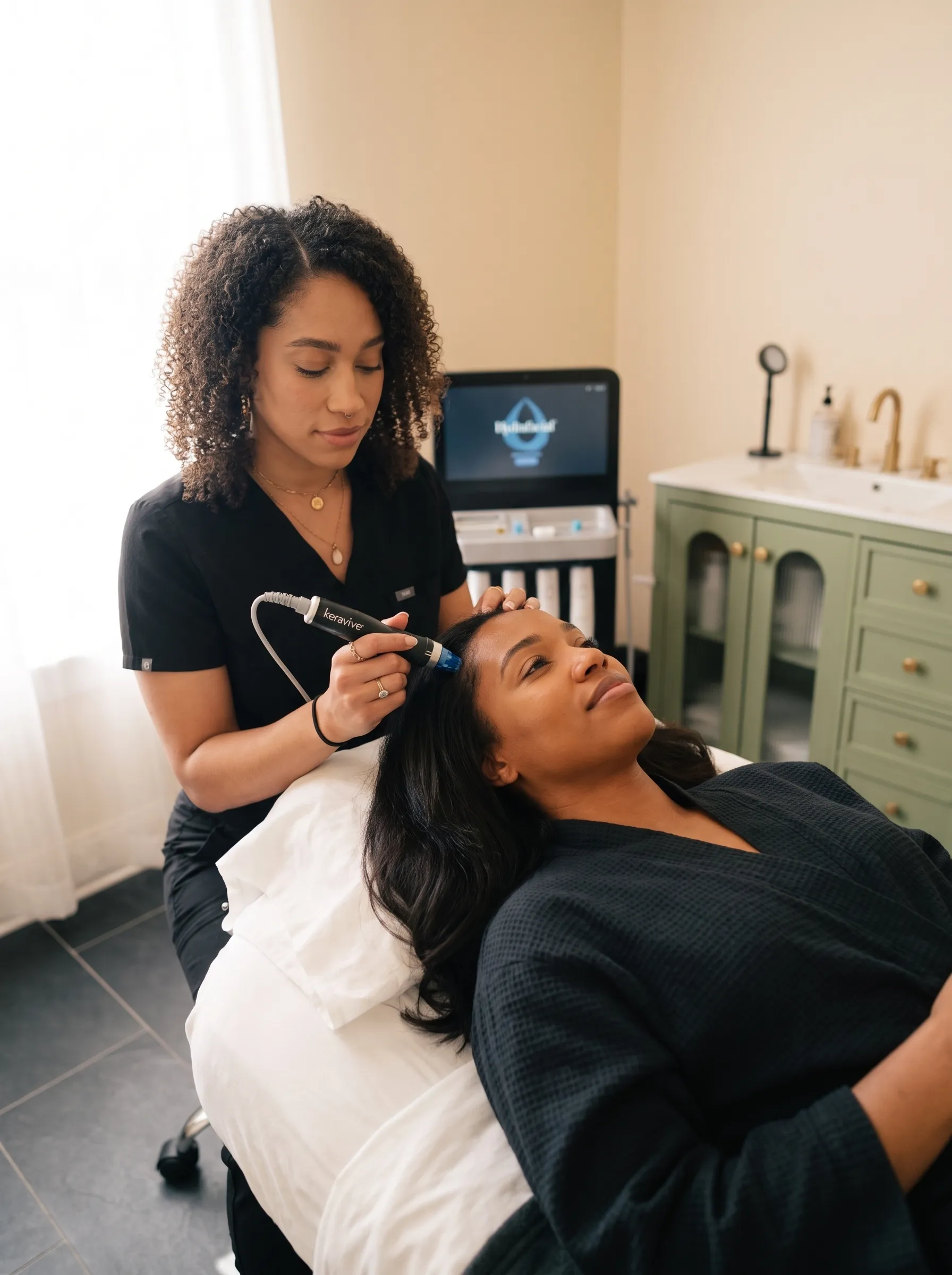
Keravive scalp treatment for La Jolla ocean swimmers addressing salt water and UV damage

$199 · No Downtime · All Skin Tones

Dermaplane Facial in La JollaA cleared surface, so everything applied after it works.

A sterile surgical blade removes the dead surface layer and fine vellus hair in one pass, so serums reach live tissue instead of sitting on debris and makeup stops catching on texture. No downtime — the glow is immediate, which is why clients book it before events. Correct blade angle and pressure make it safe on darker skin tones. For La Jolla that means a barrier that has to hold against salt water and salt air, every session of it.

  • Sterile single-use blade
  • Safe for melanin-rich skin
  • Zero downtime — immediate glow
  • $199 as a full facial

Dermaplane Facial

$199

  • By appointment only
  • Free parking
  • Consultations included — the plan is set before you book
  • Licensed esthetician — California Board of Barbering & CosmetologyKiki performs every treatment, in a one-to-one private studio in San Diego.
  • 7+ years of corrective skin workAdvanced training in HydraFacial Syndeo, Procell microchanneling, DMK enzyme therapy, and LIRA Clinical peels.
  • Prices published before you bookNothing is quoted at the door, and the first visit includes the consultation that decides the plan.
“I've been going for 4–5 years now, and I honestly wouldn't trust anyone else with my skin.”
— Arica L., Google

Quick Answer

KIAMO Skin treats barrier damage and scalp conditions from year-round ocean exposure at a one-room facial spa in San Diego (92103), about 12 miles south of La Jolla Village via I-5. Kiki, a California licensed esthetician with 7+ years specializing in melanin-rich skin, uses HydraFacial Syndeo vortex extraction and Keravive scalp therapy for swimmers from La Jolla Cove, Windansea, and La Jolla Shores. Treatments start at $259, with series planning for ocean swimmers who need multiple visits.

The approach

Why La Jolla clients book dermaplaning — and what it will not do

Dermaplaning uses a sterile surgical blade to remove dead surface cells and the fine vellus hair on top of them. Nothing is pulled from the follicle and nothing penetrates the skin. What changes is the surface: product reaches live tissue instead of sitting on debris, and makeup stops catching on texture. But it is surface work only, and the honest limit is as important as the benefit — it does not address pigmentation or scarring, because it never reaches the cellular layer where those live. For La Jolla clients whose concern is sun damage rather than texture, a Lira peel is the right instrument and dermaplaning is the one that makes it work evenly. Kiki has 7+ years performing this on melanin-rich skin, where correct blade angle and pressure are what prevent post-inflammatory hyperpigmentation.

The local concern

What does year-round ocean exposure actually do to skin and scalp?

La Jolla has a genuine, year-round ocean swimming culture — the La Jolla Cove Swim Club has operated since 1916, and a group swims there every morning regardless of season. Windansea has a year-round surf community, La Jolla Shores draws swimmers and divers, and the blufftop above the Cove gets direct afternoon sun with no tree cover. Salt water strips the skin barrier with every session — the rinse afterward removes the salt but also washes away the oils that hold the barrier together. Over weeks and months that leaves skin tight, reactive and prone to sensitivity under products it used to tolerate. The scalp takes it hardest: the part line receives UV directly, salt builds up under hair, and daily rinsing never fully clears it. Keravive scalp therapy was built for exactly that state — it clears the buildup, delivers growth factors into the follicle, and rehydrates the scalp skin. A HydraFacial does the same structural work on the face: cleanse, extract and infuse without the abrasion that sensitised skin cannot handle.

What sets it apart

What dermaplaning in La Jolla actually does

Three steps, and the constraint on the middle one is deliberate:

  • The skin is cleansed and taken completely dry — residual moisture changes how the blade sits
  • The blade is held at a fixed angle and drawn in short, controlled strokes, section by section
  • Active or pustular acne is worked around rather than over
  • Serums applied while absorption is at its highest, and the treatment closes with SPF
  • Vellus hair returns exactly as it was — it cannot grow back thicker, because the blade does not touch the follicle

The process

What happens in the room

Sessions run 45 minutes, with no downtime afterwards — which is why La Jolla clients book dermaplaning for events and before important occasions.

  1. 01

    Cleanse and dry

  2. 02

    The pass

  3. 03

    Treat and protect

Why La Jolla Skin Needs a Calibrated Exfoliation

La Jolla gets direct sun on an unusual number of surfaces. The blufftop above the Cove has no tree cover, and the coastal paths running from Windansea to La Jolla Shores follow open shoreline for most of the way. Between a morning group swim at the Cove and an afternoon walk on the bluff, La Jolla skin collects more ultraviolet exposure than most San Diego skin — and it collects it year-round rather than in a summer block. The visible result is a surface that photographs unevenly, holds dead cells longer than it should, and wears a fine layer of vellus hair that catches every product applied to it.

That combination is what dermaplaning addresses. It is not a treatment for UV damage itself, and any studio that markets it that way is selling a promise the blade cannot keep. What it is: a mechanical removal of the dead surface layer and the fine hair sitting on top of it. A reset that lets everything applied afterward reach live tissue instead of resting on debris. For a La Jolla client who spends the day outdoors and still wants results without a recovery window, that reset is the piece most corrective protocols are missing.

The setting matters because the alternative — chemical exfoliation at home, week after week, at whatever strength feels right — is where most La Jolla clients arrive. That approach inflames the skin, strips the barrier that coastal wind and salt have already worked on, and leaves the surface rougher than it started. A controlled blade pass in a studio is a different proposition: one dose, one angle, one controlled environment.

What Dermaplaning Actually Removes, and What It Does Not

A dermaplane uses a sterile surgical blade held at a fixed angle and drawn across dry skin in short, controlled strokes, section by section. It removes dead surface cells and vellus hair. It does not pull hair from the follicle, and it does not penetrate the skin. Nothing about the procedure touches the deeper layers where sun damage and pigment settle, which is exactly why it stays safe on melanin-rich skin. A surface-level removal is very unlikely to trigger the inflammatory response that produces post-inflammatory hyperpigmentation.

That distinction answers most of the questions La Jolla clients bring about dermaplaning on darker skin. The concern with resurfacing treatments in Fitzpatrick IV-VI skin is that inflammation drives excess melanin into the upper layers and leaves a dark mark behind. A blade working on the stratum corneum does not generate that kind of inflammation. Correct blade angle and light pressure are what keep it that way, and those are technique variables rather than skin-type variables — which is why the studio treats every Fitzpatrick type with the same protocol.

The vellus hair returns a few weeks later exactly as it was: same texture, same colour, same growth pattern. It cannot grow back thicker, because the blade never touches the follicle. The thing that does change is the surface — smoother, less fuzzy, and far more receptive to everything that goes on afterwards.

When Dermaplaning Is the Wrong Call in La Jolla

There are three situations where the studio skips the blade, and all three are worth naming before booking rather than after arriving. The first is active or inflamed acne. The blade is worked around active breakouts rather than across the infected skin, and a face carrying a heavy active breakout is a better candidate for a hydra facial that clears the active state first.

The second is a compromised barrier. Skin that stings under moisturizer, flakes despite hydration, or reacts to products it used to tolerate is not ready for mechanical exfoliation. The DMK Enzyme Therapy protocol is the right starting point there — it rebuilds the foundation that the rest of the corrective work depends on.

The third is the one La Jolla clients most often push back on: a sunburn. Skin that is still hot, tender, or visibly pink from recent sun exposure gets no blade at all, because inflammation is precisely what should not be added to it. The June gloom is not sun protection journal piece explains why coastal UV exposure is easier to underestimate than inland exposure, even in the middle of a foggy season.

Dermaplaning or a Lira Peel in La Jolla

This is the question the consultation actually answers, because the two treatments work on different layers. Dermaplaning removes what is on the surface. A chemical peel places acid on the surface and lets it work into the upper layers over a controlled peel-down. If the concern is texture, makeup that catches on vellus hair, or product that sits on the skin instead of absorbing, dermaplaning is the more direct answer.

If the concern is the accumulated UV damage itself — the uneven tone, the brown patches, the mottled colour that builds over years of exposure on open coastal surfaces — then a Lira chemical peel series is the treatment that reaches it. The Gentle Renewal peel is $199 and the Advanced peel is $299, with strength escalating across a series spaced every four to six weeks. A cleared surface actually makes the acid work more evenly, which is why the two are so often paired rather than chosen between.

For persistent melasma — the deeper, more patterned pigment that shows across the cheeks, forehead and upper lip — the hyperpigmentation protocol is the right path, and dermaplaning is the surface preparation that helps it along. If it is not clear which of the three is being dealt with, the three kinds of dark mark journal piece is the fastest way to tell the three apart before booking anything.

What La Jolla Clients Should Expect

The session opens with a cleanse and the skin taken completely dry — dermaplaning is performed on a dry surface, because any residual moisture changes how the blade sits. The blade pass comes next: section by section, short controlled strokes, with active or pustular acne worked around rather than over. Then the serums go on, and this is where the change becomes visible to everyone else. With the surface barrier of dead cells gone, absorption is at its highest, so the treatment actives actually land. The session closes with SPF, which matters more in La Jolla than almost anywhere else in the city.

There is zero downtime. Skin may look lightly flushed for a short while afterward, and the glow is immediate, which is why dermaplaning gets booked ahead of events. The full facial is $199, and it is often paired with a peel because a cleared surface lets the acid work evenly.

What dermaplaning will not do is rebuild the barrier that salt water and wind have stripped, and it will not lift pigment that has settled below the epidermis. For a La Jolla client who swims at the Cove most mornings, a hydra facial in the same cycle is often the better structural half of the plan. The La Jolla facial page covers how the two combine across a year of coastal exposure.

Drive Time and Logistics from La Jolla

From La Jolla Village near Prospect Street and the Cove, take Torrey Pines Road south — not Coast Highway — to I-5 past UCSD and Rose Canyon, exiting at Washington Street. Twelve miles, roughly twenty minutes outside the commute. From Bird Rock, head north on La Jolla Boulevard to La Jolla Parkway east to I-5 south. From La Jolla Shores near Scripps Institution, Torrey Pines Road south picks up I-5 near UCSD. From the UCSD campus itself, La Jolla Village Drive east drops directly onto I-5 south, and the campus is only ten miles from Mission Hills.

Southbound I-5 stacks through UTC and Sorrento Valley during the morning commute, so mid-morning and early afternoon are consistently the easier windows for the drive down from the Village or the Cove. Most La Jolla clients book mid-morning, which also means arriving before the afternoon blufftop sun has had a chance to undo the work.

The studio is at 3067 Reynard Way in Mission Hills, off Washington Street, with free parking on site. Every appointment is one-to-one with Kiki, a licensed esthetician with seven years of experience treating sun-damaged skin and melanin-rich skin across all Fitzpatrick types. By appointment only, so a space is always there when you arrive.

Full directions, neighborhood context, and what to expect at a first visit are on the La Jolla service area page.

Who books this

Who books dermaplaning in La Jolla

La Jolla clients most often book dermaplaning for texture and for makeup that clings to fine facial hair — and for events, because there is zero downtime and the glow is immediate. Others book it as the surface step that makes a peel work evenly, or as maintenance between corrective sessions. KIAMO Skin fits when the priority is a treatment that says plainly what it does and does not do: it refines the surface and prepares it for what comes next, and it is not the answer for melasma or scarring. Published pricing, one practitioner, no downtime.

Getting here

How to reach us from La Jolla

From La Jolla Village Drive, take I-5 south to the Washington Street exit, head west on Washington Street to Reynard Way and turn right. The studio is at 3067 Reynard Way. From UCSD, take Gilman Drive to I-5 south. From La Jolla Shores, take Torrey Pines Road to La Jolla Village Drive, then I-5 south. Free parking on site.

Quick Answer

Dermaplaning at KIAMO Skin in San Diego is a physical exfoliation that removes surface buildup and vellus hair with a sterile blade, creating a smoother surface that lets everything after it work better. Kiki performs every session. $199 as a dermaplane facial.

Before you commit

The price comes first

The Dermaplane Facial is $199. Nothing is quoted at the door.

Nothing is treated before it is assessed

A full consultation and skin analysis come first, and the treatment is chosen around what your skin is doing that day.

A stated cancellation window

Please give 48 hours notice to reschedule. Cancellations inside 24 hours are charged 50% of the service; no-shows are charged in full.

Every Google review of the studio is published in full, named and dated, at the reviews page.

Before you book

La Jolla questions, answered

Does dermaplaning help with sun damage or only with texture?
Only with texture, and it is worth being precise about the difference. Dermaplaning removes dead surface cells and vellus hair with a sterile blade, so it improves the feel of the skin, evens the way makeup sits, and lets serums absorb better. It does not reach the pigment or the structural change that years of UV exposure cause in the deeper layers. For brown patches, mottled tone, or melasma, the treatment that addresses the pigment is a chemical peel series — the Lira Gentle Renewal peel is $199 and the Advanced peel is $299, with strength escalating every four to six weeks. Dermaplaning is frequently paired with a peel, because a cleared surface lets the acid work evenly.
Is dermaplaning safe on skin that has been sunburned?
Not while the skin is still reacting. A sunburn is inflammation, and adding mechanical exfoliation to inflamed skin is the wrong sequence. Skin that is still hot, tender, or visibly pink gets no blade at all — the studio works around it or skips the treatment entirely. Once the skin has returned to normal and the barrier has settled, dermaplaning is safe. That is the reason every treatment closes with SPF and why recent sun exposure comes up at consultation. For skin that reacts this way regularly, the DMK Enzyme Therapy protocol rebuilds the barrier before any blade work begins.
What does dermaplaning do to the dark marks left behind by old acne?
It removes the dead surface layer sitting on top of the mark, which makes it look less obvious right away, but it does not remove the pigment itself. Post-inflammatory hyperpigmentation sits in the upper layers of skin and responds to pigment-calming peels rather than to a blade. A Lira peel series is the protocol that fades those marks. Dermaplaning is still useful alongside it, because a cleared surface means the peel acid reaches evenly and the mark fades more predictably. The three kinds of dark mark journal piece explains how to tell post-inflammatory marks from melasma and from true scarring before choosing a protocol.
Is dermaplaning worth it for La Jolla clients who spend every day outdoors?
It depends on what you want it to do. If you want smoother texture, makeup that stops catching on vellus hair, and product that actually absorbs, dermaplaning is one of the few treatments that delivers all three with zero downtime and an immediate glow — the full facial is $199. If you want the sun damage itself to change, a peel series is the treatment that reaches the pigment, and daily SPF is the only thing that stops new exposure from undoing the result. Clients who combine the two do better than clients who book either one alone. The consultation is where that sequence gets decided.
Does dermaplaning work if you swim in the ocean the same week?
Yes, but order it. Salt water strips the skin barrier, so swimming the day after a dermaplane puts freshly treated skin in contact with salt and sun with no barrier of its own. The better sequence is dermaplaning first, then SPF, then the swim — and a hydra facial in the same cycle to rebuild what the salt took out. The studio asks about recent swimming at consultation, because ocean exposure changes the plan. The La Jolla service area page covers how the swim culture and the treatment calendar interact across a full week.
3067 Reynard Way
San Diego, CA 92103

Off Washington Street — minutes from Hillcrest, Bankers Hill and Little Italy.

(310) 595-0872

[email protected]

By appointment only · Free parking

Request AppointmentCall the studio at (310) 595-0872