Skip to content
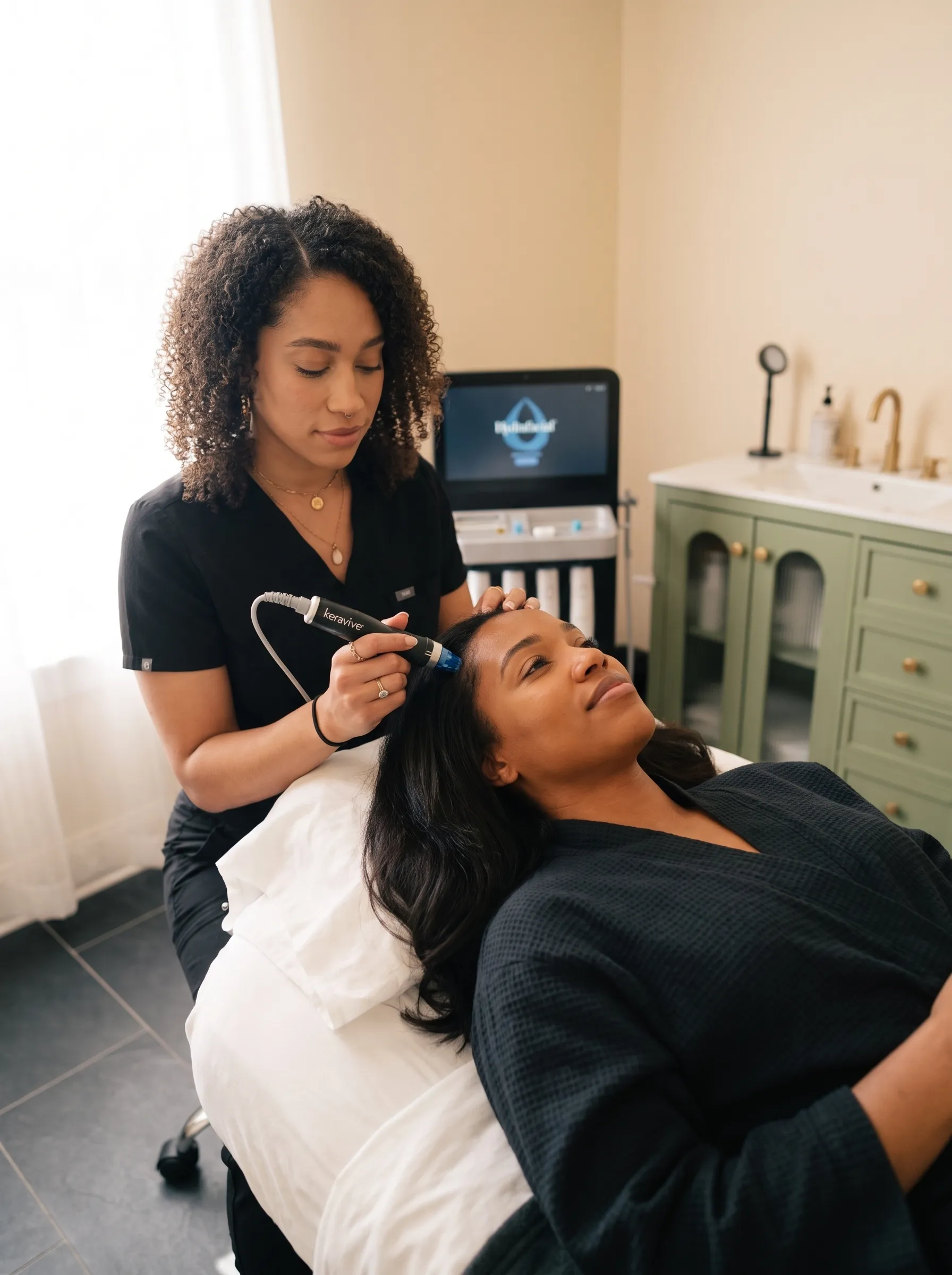
Keravive scalp treatment for La Jolla ocean swimmers addressing salt water and UV damage

Syndeo Device · Custom Booster · LED Included

HydraFacial in La JollaMedical-grade extraction with a booster chosen for your skin.

Enzymatic resurfacing, calibrated vortex extraction, and precision infusion of hydration and antioxidants — in one 45-minute appointment with no downtime. The booster is selected from the device’s skin analysis, and LED light therapy is included rather than sold as an add-on. $259 per session, or $249 for a first visit with the consultation. For La Jolla that means a barrier that has to hold against salt water and salt air, every session of it.

  • HydraFacial Syndeo — AI skin analysis
  • Safe for melanin-rich skin, no heat or laser
  • LED light therapy included every visit
  • No downtime — back to your day

First-Time Client Treatment

$249

  • By appointment only
  • Free parking
  • Consultations included — the plan is set before you book
  • Licensed esthetician — California Board of Barbering & CosmetologyKiki performs every treatment, in a one-to-one private studio in San Diego.
  • 7+ years of corrective skin workAdvanced training in HydraFacial Syndeo, Procell microchanneling, DMK enzyme therapy, and LIRA Clinical peels.
  • Prices published before you bookNothing is quoted at the door, and the first visit includes the consultation that decides the plan.
“I've been going for 4–5 years now, and I honestly wouldn't trust anyone else with my skin.”
— Arica L., Google

Quick Answer

KIAMO Skin treats barrier damage and scalp conditions from year-round ocean exposure at a one-room facial spa in San Diego (92103), about 12 miles south of La Jolla Village via I-5. Kiki, a California licensed esthetician with 7+ years specializing in melanin-rich skin, uses HydraFacial Syndeo vortex extraction and Keravive scalp therapy for swimmers from La Jolla Cove, Windansea, and La Jolla Shores. Treatments start at $259, with series planning for ocean swimmers who need multiple visits.

The approach

Why La Jolla clients book the HydraFacial Syndeo

La Jolla has a genuine year-round ocean swimming culture — the Cove Swim Club has run since 1916 and a group swims every morning regardless of season. Windansea has a year-round surf community, La Jolla Shores draws swimmers and divers, and the blufftop above the Cove gets direct afternoon sun with no tree cover. That is a specific combination of exposure, and it is what the Syndeo is built for: enzymatic resurfacing that clears what salt and wind leave behind, vortex extraction calibrated to 30-70 mmHg rather than set to a fixed pressure, and AI skin analysis that reads hydration and congestion before anything is chosen. Kiki has 7+ years performing every session personally, and the protocols are selected for the skin tone in front of you.

The local concern

What does year-round ocean exposure actually do to skin and scalp?

La Jolla has a genuine, year-round ocean swimming culture — the La Jolla Cove Swim Club has operated since 1916, and a group swims there every morning regardless of season. Windansea has a year-round surf community, La Jolla Shores draws swimmers and divers, and the blufftop above the Cove gets direct afternoon sun with no tree cover. Salt water strips the skin barrier with every session — the rinse afterward removes the salt but also washes away the oils that hold the barrier together. Over weeks and months that leaves skin tight, reactive and prone to sensitivity under products it used to tolerate. The scalp takes it hardest: the part line receives UV directly, salt builds up under hair, and daily rinsing never fully clears it. Keravive scalp therapy was built for exactly that state — it clears the buildup, delivers growth factors into the follicle, and rehydrates the scalp skin. A HydraFacial does the same structural work on the face: cleanse, extract and infuse without the abrasion that sensitised skin cannot handle.

What sets it apart

What a HydraFacial in La Jolla actually does

Three clinical actions at once, calibrated by the device and by the practitioner:

  • Enzymatic resurfacing that lifts dead surface cells without abrasive scrubbing
  • Vortex extraction at controlled suction, clearing the mineral deposits hard water leaves in the follicles
  • Precision infusion of hydration and antioxidants while the pores remain receptive
  • A booster selected from the AI reading — brightening where pigment is the concern, barrier support where dehydration is
  • LED light therapy at every appointment, included rather than sold as an add-on

The process

What happens in the room

Sessions run 45 minutes. The order matters: the surface is cleared before anything is driven in, so the booster arrives on receptive skin rather than on debris.

  1. 01

    Cleanse & resurface

  2. 02

    Extract & hydrate

  3. 03

    Boost

Why Ocean Swimming Damages Skin

The Pacific Ocean contains roughly 35 parts per thousand of dissolved salt—primarily sodium chloride, but also magnesium, calcium, and potassium salts. When salt water dries on skin, those minerals bond with sebum, the natural oil your skin produces to protect itself. The rinse you take after swimming removes the salt, but it also washes away the sebum-salt complex. Over one session, that is manageable. Over weeks and months of daily swimming, the cumulative effect leaves skin tight, reactive, and chronically dehydrated.

The problem is not the salt alone—it is the cycle. Swim, rinse, repeat. Each rinse strips a little more of the barrier, and the skin never fully recovers between sessions. La Jolla swimmers face this year-round, not seasonally. The Cove is swimmable in January, and Windansea holds surf in every month. There is no off-season where the barrier gets a chance to rebuild on its own.

Wind off the bluffs compounds the issue. The cliffs above the Cove and the open exposure at Windansea mean wind hits wet skin while you are still dripping, accelerating evaporation and pulling moisture out before you even towel off. The combination of salt, wind, and repeated rinsing creates a state dermatologists call transepidermal water loss—the skin cannot hold hydration because the barrier that would normally prevent evaporation is no longer intact.

UV adds the final layer. The blufftop above the Cove receives direct afternoon sun with no tree cover, and swimmers coming out of the water stand in full sun while they dry off. UVA penetrates the marine layer even on gray mornings, and it drives oxidative stress in skin that is already compromised. Sun damage and barrier damage are not the same problem, but they reinforce each other—one makes the other worse.

How HydraFacial Addresses Salt Water Damage

HydraFacial Syndeo performs three actions simultaneously, and all three matter for salt-damaged skin. First, enzymatic resurfacing lifts the layer of dead cells and salt residue that builds up on the surface. This is not mechanical scrubbing—it is a chemical process that loosens debris without the abrasion a compromised barrier cannot handle.

Second, vortex extraction vacuums salt deposits and mineral buildup out of follicles at controlled pressure—30 to 70 millimeters of mercury, calibrated to remove congestion without traumatizing the skin. San Diego's municipal water contains 280 to 320 parts per million of dissolved minerals, which means even the rinse you take after swimming leaves calcium and magnesium deposits in your pores. Standard cleansing does not clear those. Vortex extraction does.

Third, peptide infusion floods the skin with hydration and growth factors while pores are still open and receptive. The booster serum is selected based on what your skin needs that day—for swimmers, that usually means hyaluronic acid to bind water into the tissue and peptides to support barrier repair. The infusion happens under the same vacuum pressure that just cleared the follicles, which drives the active ingredients deeper than topical application alone would reach.

The treatment takes roughly forty-five minutes, and there is no downtime. You can swim the next day if the skin feels ready, though most people wait twenty-four hours to let the barrier settle. The result is immediate hydration, reduced tightness, and skin that stops stinging under products. One session addresses the acute damage. A series addresses the cumulative state most year-round swimmers are in—where the barrier has been eroding for months and needs more than one rebuild cycle to stabilize.

LED light therapy follows every HydraFacial at KIAMO Skin. Red and near-infrared wavelengths reduce inflammation from wind and UV exposure, and they support the cellular repair the peptides just initiated. This is included in every session, not an add-on.

What La Jolla Swimmers Should Expect

The first HydraFacial will feel like relief. Skin that was tight and reactive before treatment feels plump and calm afterward, and the tightness that used to set in within hours of swimming takes longer to return. That immediate response is hydration—the vortex infusion replaced what salt and rinsing stripped away.

The deeper repair happens over a series. Barrier function rebuilds in layers, not in one session, and swimmers who are in the water four to six days a week are stripping the barrier faster than a single treatment can rebuild it. Most La Jolla swimmers book monthly maintenance during active swimming season—the season being year-round here, which is the whole reason this treatment exists in the first place.

Home care between sessions matters. A barrier repair serum applied morning and night supports the work the HydraFacial started, and mineral sunscreen prevents UV from undoing it. The serum recommendation is specific to what your skin showed during the treatment—KIAMO Skin does not sell a fixed product line, so the recommendation is clinical, not commercial.

The timeline for full barrier restoration depends on how compromised the skin is when you start. Two to three treatments over two to three months is the usual plan for swimmers with moderate damage. Severe cases—skin that stings under everything, flakes despite moisturizer, or stays red for hours after swimming—may need enzyme therapy instead of or in addition to HydraFacial. That is a consultation call, not something you can self-diagnose.

Results hold as long as you maintain them. A monthly HydraFacial during swimming season keeps the barrier ahead of the damage cycle. Stop the maintenance, and the tightness returns within weeks. This is not a cure—it is management of an ongoing exposure.

When HydraFacial Is Not Enough

HydraFacial works for barriers that are damaged but still functional. If your skin has crossed into a state where it reacts to almost everything—stinging under plain moisturizer, staying red for hours after swimming, flaking despite hydration—that is a compromised barrier that needs enzymatic repair, not just hydration.

DMK Enzyme Therapy rebuilds barrier function at a deeper level than HydraFacial reaches. The enzyme masque works with the skin's own processes to restore healthy circulation and lymphatic activity, which supports long-term barrier integrity rather than just replacing lost hydration. It is the treatment for swimmers whose skin has been reactive for months and nothing topical has fixed it.

The decision between HydraFacial and enzyme therapy is made at consultation based on what the skin shows that day. If the barrier is intact but dehydrated, HydraFacial is the answer. If the barrier is compromised to the point of chronic reactivity, enzyme therapy comes first. Both can be part of the same plan—enzyme therapy to rebuild, then HydraFacial to maintain once the barrier stabilizes.

Keravive scalp therapy addresses the same salt buildup on the scalp that HydraFacial clears from the face. The part line takes as much salt and UV as the cheeks, and daily rinsing never fully clears it. Keravive uses the same vortex technology to extract buildup from the scalp and deliver peptides directly to the follicles. If your scalp feels tight, flaky, or dry despite regular shampooing, that is salt residue and mineral deposits—not dandruff.

Drive Time and Logistics from La Jolla

From La Jolla Village near Prospect Street and the Cove, take Torrey Pines Road south—not Coast Highway—to I-5 past UCSD and Rose Canyon, exiting at Washington Street. Twelve miles, roughly twenty minutes outside the commute. From Bird Rock, head north on La Jolla Boulevard to La Jolla Parkway east to I-5 south. From La Jolla Shores near Scripps Institution, Torrey Pines Road south picks up I-5 near UCSD.

Southbound I-5 stacks through UTC and Sorrento Valley during the morning commute. Mid-morning and early afternoon are consistently the easier windows for the drive down. Most La Jolla swimmers book morning appointments before hitting the water, or early afternoon after a morning swim.

The studio is at 3067 Reynard Way in Mission Hills, off Washington Street. Free parking on site. By appointment only, so a space is always available when you arrive. Appointments are one-to-one with Kiki, a California licensed esthetician with seven years treating barrier damage and pigmentation in all skin types, including melanin-rich skin.

Full directions, neighborhood context, and what to expect at a first visit are on the{' '} La Jolla service area page .

Who books this

Who books a HydraFacial in La Jolla

La Jolla clients book for the damage a life lived in and out of the water produces: skin that is tight after a swim, reactive to products it tolerated before, and carrying the congestion that salt and hard water leave behind. Many also book the HydraFacial as the maintenance layer between corrective sessions, because a cleared surface lets a peel work evenly rather than over debris. KIAMO Skin fits when the priority is a treatment selected for the skin on the day, published pricing, and one practitioner across the whole course.

Getting here

How to reach us from La Jolla

From La Jolla Village Drive, take I-5 south to the Washington Street exit, head west on Washington Street to Reynard Way and turn right. The studio is at 3067 Reynard Way. From UCSD, take Gilman Drive to I-5 south. From La Jolla Shores, take Torrey Pines Road to La Jolla Village Drive, then I-5 south. Free parking on site.

Quick Answer

A HydraFacial at KIAMO Skin in San Diego is a medical-grade facial performed on a HydraFacial Syndeo device by Kiki, a California licensed esthetician with 7+ years of experience. It combines cleansing, exfoliation, extraction, and hydration with a customized booster, followed by LED light therapy — $259 per session, or $249 for a first-time client including the consultation that sets the plan.

Before you commit

The price comes first

A HydraFacial is $259, and the first-time client treatment is $249 including the consultation that decides the plan. Nothing is quoted at the door.

Nothing is treated before it is assessed

A full consultation and skin analysis come first, and the treatment is chosen around what your skin is doing that day.

A stated cancellation window

Please give 48 hours notice to reschedule. Cancellations inside 24 hours are charged 50% of the service; no-shows are charged in full.

Every Google review of the studio is published in full, named and dated, at the reviews page.

Before you book

La Jolla questions, answered

How soon after swimming can I get a HydraFacial?
Same day is fine if the skin is not actively irritated. Most swimmers book morning appointments before their swim, or afternoon appointments a few hours after getting out. If your skin is red, stinging, or visibly inflamed from a long session in rough water, wait twenty-four hours to let the acute inflammation settle. The HydraFacial will not make inflamed skin worse, but it works better on skin that is damaged but calm.
Will HydraFacial prevent salt buildup or just treat it?
It treats existing buildup and temporarily prevents accumulation by clearing the follicles, but it does not stop salt from bonding with sebum the next time you swim. Think of it as resetting the baseline. Monthly treatments keep the buildup from reaching the point where it affects how your skin feels and functions. Between treatments, barrier repair serums and thorough rinsing after swimming help slow the rate at which salt re-accumulates.
How often do La Jolla ocean swimmers need HydraFacial?
Monthly maintenance is the standard plan for swimmers in the water four to six days a week year-round. If you swim less frequently—two to three times a week, or only during warmer months—every six to eight weeks may be enough. The cadence is set at consultation based on how quickly your barrier recovers between sessions, not on a fixed protocol.
Can I swim the same day after HydraFacial treatment?
You can, but most people wait twenty-four hours. The vortex extraction and peptide infusion leave the skin more receptive than usual, which also means more vulnerable to irritation for the first few hours. Swimming immediately after treatment will not undo the HydraFacial, but it does mean you are stripping the barrier again before it has had a chance to stabilize. If you must swim the same day, wait at least six hours and apply a barrier cream before entering the water.
What is the difference between this and a spa facial after swimming?
Spa facials use steam, manual extraction, and massage. Steam opens pores but does not remove mineral deposits. Manual extraction can traumatize skin that is already compromised from salt exposure. Massage feels good but does not address the barrier damage that is causing the tightness in the first place. HydraFacial Syndeo uses a medical-grade device with controlled vacuum pressure calibrated to remove salt and mineral buildup without trauma. The peptide infusion is delivered under pressure, which drives hydration deeper than topical application. This is clinical equipment designed for barrier repair, not relaxation. The goal is functional skin, not a relaxing hour.
3067 Reynard Way
San Diego, CA 92103

Off Washington Street — minutes from Hillcrest, Bankers Hill and Little Italy.

(310) 595-0872

[email protected]

By appointment only · Free parking

Request AppointmentCall the studio at (310) 595-0872