Why Pacific Beach Skin Shows UV Damage
Pacific Beach sits inside the May Gray belt, the stretch of San Diego coastline where the marine layer sits heaviest from late May through July. The light looks dim and the air feels cool, and the natural assumption is that there is nothing to protect against. The UV index across Pacific Beach in those months still hits 8 to 10, and UVA passes through thin marine layer with very little loss. Pigment cells respond to UVA and to heat as well as to UVB, and in melanin-rich skin that response is enthusiastic.
The damage is cumulative rather than acute. A single overcast morning on the boardwalk does not produce a visible change. The pattern that produces pigmentation is the one that runs for six to eight weeks: daily exposure without the sensory cue that would normally trigger sunscreen, followed by a clear-signal day that arrives without warning. The pigment shows up in August, by which point the exposure that caused it is months behind you and the trigger is invisible.
Pacific Beach adds heat to the equation. The boardwalk and the Belmont Park area run several degrees warmer than the cliffs at La Jolla, and heat is its own pigmentation driver independent of UV. Melasma in particular responds to a combination of UVA, heat, and hormones. Pacific Beach is a more aggressive UV environment than the geography suggests, and the skin that lives in it year-round is paying for the misread.
Salt adds another layer. Surfers and open-water swimmers at Tourmaline, Crystal Pier, and the Pacific Beach pier get the same salt-and-rinse cycle as La Jolla swimmers, and the same mineral buildup in the follicles. For non-surfers, the Pacific Beach afternoon at the beach is enough exposure to count. The barrier is being asked to do more than it can keep up with.
How HydraFacial Reverses the Surface Layer
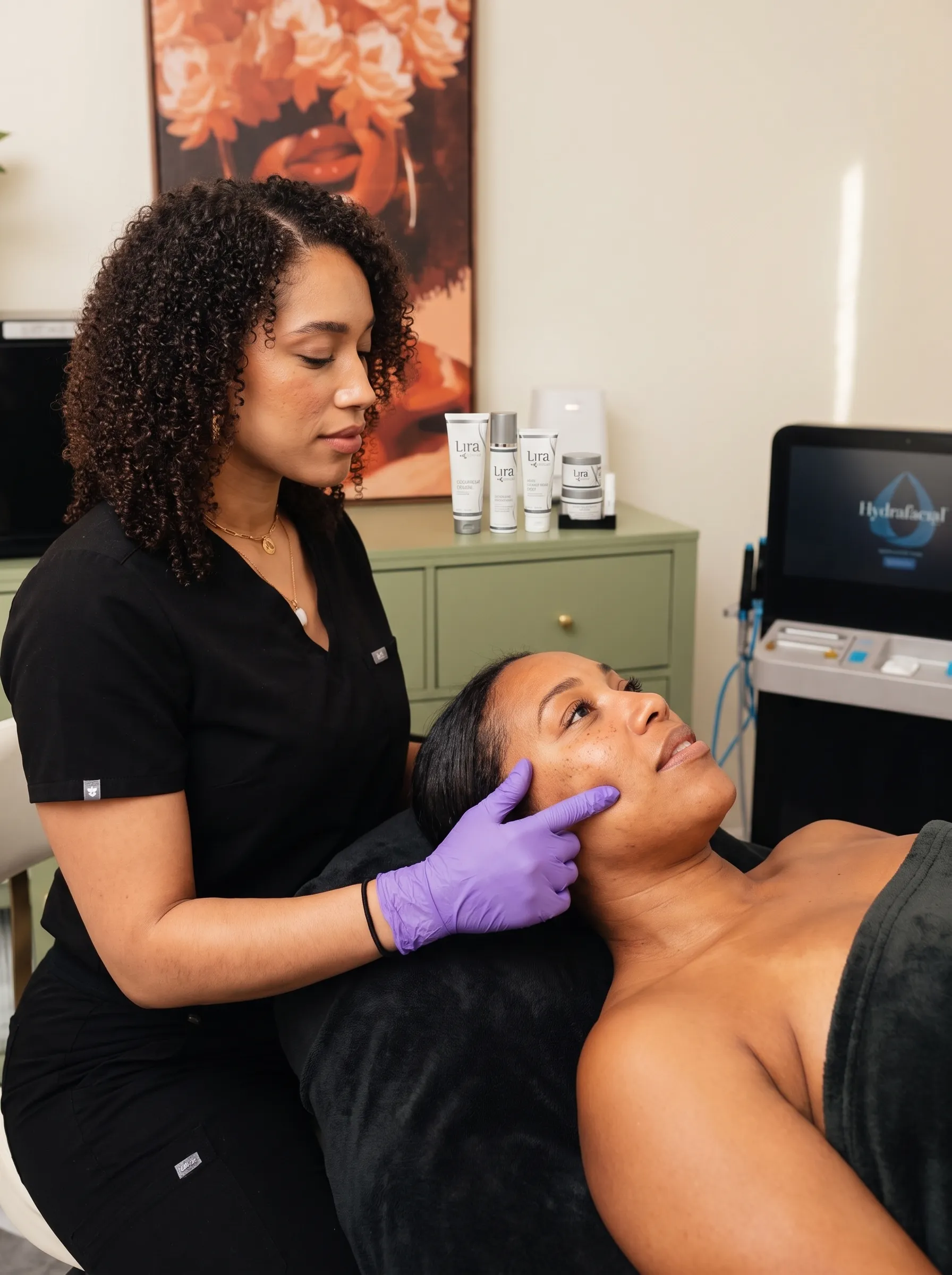
HydraFacial Syndeo at KIAMO Skin performs three actions, and all three matter for UV-loaded Pacific Beach skin. First, enzymatic resurfacing lifts the layer of dead cells and surface pigment that the UV exposure has been driving upward. This is not mechanical scrubbing — it is a chemical process that loosens debris without the abrasion a barrier that has been working overtime cannot afford.
Second, vortex extraction vacuums mineral deposits and oxidized sebum out of follicles at controlled pressure. Pacific Beach residents who are also in the water get the same salt buildup as La Jolla swimmers. Residents who are not in the water still get the mineral residue from San Diego's hard water — local supply runs 16 grains per gallon, which means every rinse leaves calcium and magnesium in the pores. Standard cleansing does not clear it.
Third, peptide infusion floods the skin with hydration while the pores are still open and receptive. The booster serum is selected at consultation based on what your skin is doing that day — for Pacific Beach clients in late summer, that usually means a pigment-calming peptide stack layered over hyaluronic acid. The infusion happens under the same vacuum pressure that just cleared the follicles, which drives the active ingredients deeper than topical application alone would reach.
LED light therapy follows every HydraFacial at KIAMO Skin. Red and near-infrared wavelengths reduce the inflammation UV has been driving at the cellular level, and they support the repair the peptides just initiated. This is included in every session, not an add-on.
The treatment takes about forty-five minutes, and there is no downtime. You can be back at the beach the next day if the skin feels ready, though most clients wait twenty-four hours to let the barrier settle. The result is immediate hydration, reduced reactivity, and skin that stops stinging under products that were stinging before. One session addresses the acute state. A series addresses the cumulative state most Pacific Beach residents are in by the time they book.
What Pacific Beach Clients Should Expect
The first HydraFacial will feel like reset. Skin that was tight and reactive feels plump and calm afterward, and the reactivity that used to set in within hours of sun exposure takes longer to return. That immediate response is hydration, and the pigment work is just beginning. Pigment reversal happens over a series, not in one session.
Most Pacific Beach clients book monthly maintenance during the high-UV months — May through October, roughly. The cadence is set at consultation based on how the skin is responding and how much cumulative exposure the calendar is asking for. Off-season, every six to eight weeks is often enough to hold the gains.
Home care between sessions matters more in Pacific Beach than in most neighborhoods, because the daily exposure does not stop. A pigment-calming serum applied morning and night supports the work the HydraFacial started, and a broad-spectrum mineral sunscreen reapplied every two hours during beach time is the single most important variable. The sunscreen recommendation at KIAMO Skin is specific to the skin in front of the esthetician — the studio does not sell a fixed product line, so the recommendation is clinical, not commercial.
The timeline for visible pigment reduction depends on how deep the pigment sits and how long it has been accumulating. Two to three treatments over two to three months is a reasonable starting point. More entrenched pigment — the kind that has been building for years — may need a Lira peel or Procell microchanneling layered in. That is a consultation call, not a self-diagnosis.
When HydraFacial Is Not Enough
HydraFacial works for skin that is UV-loaded but still functional. If the barrier has crossed into a state where it reacts to almost everything — stinging under plain moisturizer, staying pink for hours after sun exposure, flaking despite hydration — the skin needs enzymatic repair before any pigment work can hold.
DMK Enzyme Therapy rebuilds barrier function at a deeper level than HydraFacial reaches. The enzyme masque works with the skin's own processes to restore healthy circulation and lymphatic activity, which supports the long-term barrier integrity that lets pigment work stay put. It is the treatment for Pacific Beach skin that has been reactive for months and nothing topical has fixed it.
The decision between HydraFacial and enzyme therapy is made at consultation based on what the skin shows that day. If the barrier is intact but the pigment is the concern, HydraFacial is the answer. If the barrier is compromised to the point of chronic reactivity, enzyme therapy comes first. Both can be part of the same plan — enzyme therapy to rebuild, then HydraFacial to maintain once the barrier stabilizes.
For pigment that sits deeper than the surface layer — melasma, post-inflammatory marks that did not fade over a summer, sun damage that has been accumulating for years — a Lira peel is the more direct intervention. The peel drives controlled injury to the pigmented layer, and the skin's repair response brings fresh, even-toned cells to the surface. Lira peels are calibrated for melanin-rich skin, which matters for the Pacific Beach client base specifically.
Drive Time and Logistics from Pacific Beach
From Pacific Beach, take Grand Avenue east to I-5 north, or take Garnet Avenue to I-805 north. The I-805 route skips downtown and is consistently the faster option, about fifteen minutes outside the commute. From the Crystal Pier area, Garnet east to I-805 picks up the freeway in under five minutes. From the north end near Tourmaline, take La Jolla Boulevard south to I-5.
Mid-morning and early afternoon are the easier windows for the drive. The morning rush from Pacific Beach into Mission Hills stacks on I-5 through La Jolla, and the evening commute reverses it. Most Pacific Beach clients book mid-morning appointments and are back home within the hour.
The studio is at 3067 Reynard Way in Mission Hills, off Washington Street. Free parking on site. By appointment only, so a space is always available when you arrive. Appointments are one-to-one with Kiki, a California licensed esthetician with seven years treating UV damage and pigmentation in all skin types, including melanin-rich skin.
Full directions, neighborhood context, and what to expect at a first visit are on the Pacific Beach service area page.