Journal · 9 min read
Acne scars in San Diego: which ones a facial can fix and which need microneedling
Most of the time when a facial "didn't work" for acne scarring, the scar type was never the issue. The treatment was.
Acne scars in San Diego fall into three categories: post-inflammatory hyperpigmentation (PIH), which fades with time and peels; atrophic or pitted scars (icepick, boxcar, rolling), which need microneedling at controlled depth; and hypertrophic scars, which need a different protocol entirely. Choosing between facial and microchanneling depends on the scar type, not on the brand or the price.
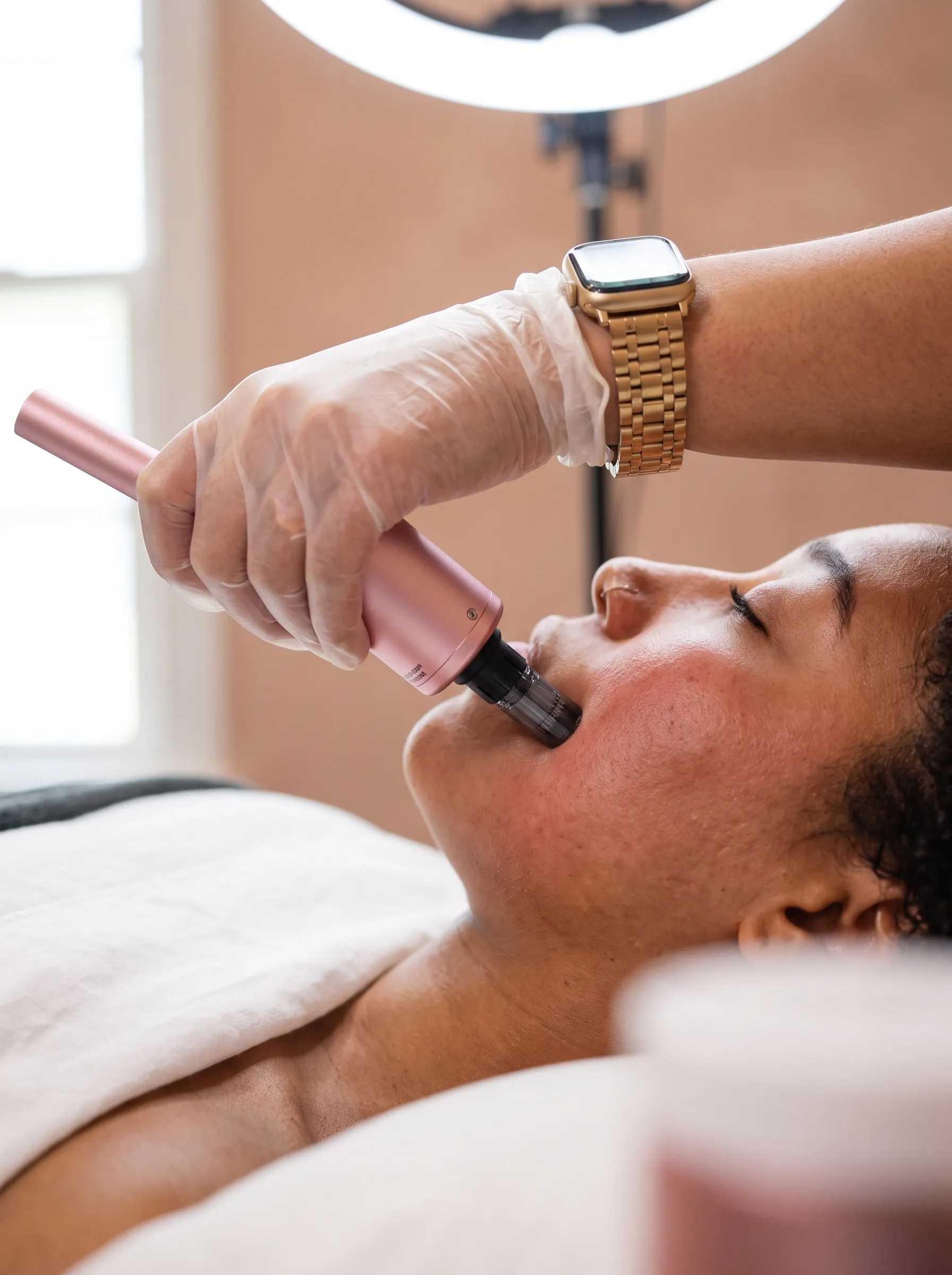
Acne scars in San Diego fall into three categories that respond to different treatments, and the most common reason a corrective plan fails is that the scar type was never correctly identified. A protocol that helps one category can make another worse, and the consultation that distinguishes between them is the step most often skipped.
The three categories of acne scars
Atrophic or pitted scars sit below the surface of the skin. The acne inflammation destroyed collagen in the healing phase, and the skin healed with a depression where the collagen used to be. Atrophic scars come in three sub-types: icepick (narrow, deep, V-shaped), boxcar (wider, shallow, U-shaped), and rolling (wide, shallow, with a wavy edge from underlying fibrous bands). Each sub-type responds to a different depth setting in the same modality.
Hypertrophic scars sit above the surface. The acne inflammation produced excess collagen during healing, and the skin healed with a raised area where the pimple was. Hypertrophic scars are less common than atrophic and are more often seen on the chest, back, and shoulders than on the face. They respond to a different protocol than atrophic scars — typically a series of steroid injections or vascular laser — and a microchanneling device will not address them.
Post-inflammatory hyperpigmentation, or PIH, is not a scar at all. PIH is the dark mark left behind after a pimple heals, and it sits in the epidermal layer. PIH fades with time and a pigment-calming protocol, and it does not require depth-controlled work to resolve. Many people who come in for "acne scar treatment" actually have PIH, and the protocol that resolves it is simpler, cheaper, and faster than the protocol for true scarring.
Why PIH is not a scar
PIH is a pigmentation response to inflammation. It sits in the epidermal layer, fades on its own over weeks to months, and responds to pigment-calming peels and serums. A true acne scar is a structural change in the skin — a depression or a raised area — and requires depth-controlled work to remodel. The two are often present on the same face, and the protocol needs to address each one separately.
For melanin-rich skin specifically, PIH is the more common concern, and the protocol that addresses it is the one most studios skip. A Lira peel series with a pigment-calming home-care protocol often resolves PIH in two to three sessions. The studio at North Park sees the pattern repeatedly: the client came in for "acne scars," the consultation identified PIH, and the peel protocol produced visible change within the first two sessions.
Why depth matters more than the device name
The marketing around microchanneling devices focuses on brand names — Procell, SkinPen, Vivace, Dermapen — as if the device were the treatment. The device is the tool. The treatment is the depth, and the depth is set per session based on the scar type and the Fitzpatrick type. A studio that uses the most expensive device at a default depth that does not match the scar is performing a different service than a studio that uses a less expensive device at a calibrated depth.
For atrophic scars specifically, Procell microchanneling is calibrated at consultation based on the scar type. Icepick scars need a deeper setting to reach the base of the scar. Boxcar scars need a shallower setting to reach the floor. Rolling scars need a depth that breaks the underlying fibrous bands. The same face often needs multiple depths in the same session, and the studio records the depth per area so the next session can be calibrated against the response.
What melanin-rich skin requires from the protocol
The default depth on most microchanneling devices is set for Fitzpatrick I-III skin. Applying that default to Fitzpatrick IV-VI skin produces inconsistent results — sometimes visible improvement, sometimes rebound hyperpigmentation that is worse than the original concern. The protocol for melanin-rich skin stays within a narrower depth window and adjusts per session based on how the first session responded. Microneedling on dark skin is safe when the depth is calibrated, and unsafe when it is not.
Barrier integrity is a separate variable that affects how the protocol works. Microchanneling on a compromised barrier — skin that is reactive, stinging under moisturizer, or flaking despite hydration — produces unpredictable results. The protocol at KIAMO Skin starts with DMK Enzyme Therapy when the barrier is compromised, and the microchanneling begins once the barrier stabilizes. The sequence is the protocol.
The realistic timeline for visible change
Acne scar revision is not a one-session result. Most clients see meaningful change by the third or fourth session, with continued improvement through the sixth. The wound-healing cascade the microchanneling initiates continues for weeks after each session, and the collagen remodeling that fills atrophic scars is cumulative. A client who expects one session and quits after two misses the result the protocol was built to produce.
PIH responds faster. A pigment-calming peel series with a consistent home-care protocol often produces visible change within the first two sessions, with continued improvement over the next two to three months. The protocol is shorter and the downtime is less, and the result is real but limited to the epidermal layer.
When to combine modalities
Most acne scar revision protocols combine modalities. PIH is addressed with peels, true atrophic scarring is addressed with microchanneling, and barrier integrity is rebuilt with enzyme therapy when needed. The protocols run in sequence based on what the skin shows at consultation, and the studio sequences them to avoid overwhelming the skin.
A common sequence: enzyme therapy to rebuild the barrier, then a peel series to clear the PIH, then microchanneling to address the atrophic scarring. Each phase runs until the skin stabilizes, and the next phase begins when the previous one has produced the change it was meant to produce. The total timeline is six months to a year, and the result is cumulative across the phases.
Acne scar revision is one of the longer corrective protocols in skin care, and the clients who get the result they came for are the ones who understand the timeline. The studio is honest about what the protocol can and cannot do, and the consultation is where that honesty starts.
Written by Kiki, Licensed Esthetician, California Board of Barbering & Cosmetology, with 7+ years treating melanin-rich skin at KIAMO Skin in Mission Hills, San Diego.
Common questions
Acne scar revision questions
What is the difference between acne scars and post-inflammatory hyperpigmentation?
How long does acne scar revision take?
Is microchanneling safe for dark skin?
Can I get a facial while I still have active acne?
Also in the journal
Three kinds of dark mark, and why one facial cannot fix all three
Choosing a facial for hyperpigmentation before you know which kind you have is the most common reason treatment fails — and occasionally the reason it backfires.
June gloom is not sun protection
The marine layer is the single most expensive misunderstanding in San Diego skincare. It looks like cover. It is not cover.
San Diego hard water and your scalp
If your scalp flakes, itches, or feels coated no matter what shampoo you buy, the shampoo may not be the variable worth changing.
Microneedling on dark skin, and why depth decides the outcome
The question is not really whether needling works on melanin-rich skin. It is whether the person holding the device has set the depth for the skin in front of them.
Is dermaplaning safe for dark skin? Here is what actually matters.
The question is not really whether dermaplaning works on darker skin. It is whether the blade angle and pressure match the skin in front of it.
Professional Scalp Treatment San Diego: Keravive for Dandruff, Flaking & Hair Health
Looking for professional scalp treatment in San Diego? KIAMO Skin offers Keravive therapy for dandruff, seborrheic dermatitis, dry scalp, and hair thinning. While over-the-counter shampoos treat surface symptoms, Keravive addresses the root cause.
San Diego Scalp Treatments: How Does Keravive Work?
Keravive is a clinical scalp treatment designed to remove years of product buildup, hard water minerals, and oil congestion that shampoo can't reach. For San Diego residents dealing with ocean humidity, hard water, and year-round sun exposure, it addresses the root causes of flaking, tightness, and hair thinning.
Hyperpigmentation Treatment Guide: What Actually Works for Dark Spots, Melasma & PIH
If you have struggled with stubborn dark spots, melasma, or uneven skin tone in San Diego, the right combination of professional treatments and medical-grade home care can produce dramatic improvement—but only if the approach is calibrated for your skin tone and pigmentation type.
How much does a chemical peel cost in San Diego?
The price of a chemical peel in San Diego varies by depth, formulation, and whether it is part of a treatment series — but the more important question is which one your skin actually needs.
Best chemical peel for melasma, and what the answer actually depends on
"Best peel for melasma" is a search query, not a clinical answer. The right peel is the one your Fitzpatrick type can tolerate every four to six weeks, repeated across a series, with melanin production quieted between sessions.
Best facial in San Diego: what "best" actually depends on
Search results and Yelp reviews are not what determines whether a facial is the best one for your skin. The consultation is.