Journal · 7 min read
Is dermaplaning safe for dark skin? Here is what actually matters.
The question is not really whether dermaplaning works on darker skin. It is whether the blade angle and pressure match the skin in front of it.
Dermaplaning is safe for Black skin when the blade angle and pressure match the skin in front of it. The treatment uses no heat and no acid - the two inputs most associated with post-inflammatory hyperpigmentation in deeper skin tones - so the risk comes from technique, not the blade itself. At 45 degrees with light, even strokes, dermaplaning for Black skin removes dead cells without reaching living tissue; a shallower angle or heavier pressure creates the micro-injury that triggers pigment production in melanin-rich melanocytes. At KIAMO Skin in Mission Hills, dermaplaning is performed by a California licensed esthetician with 7+ years treating Fitzpatrick I-VI, and is followed by broad-spectrum SPF 30+ with iron oxides because freshly exfoliated skin is more vulnerable to UV and visible light.
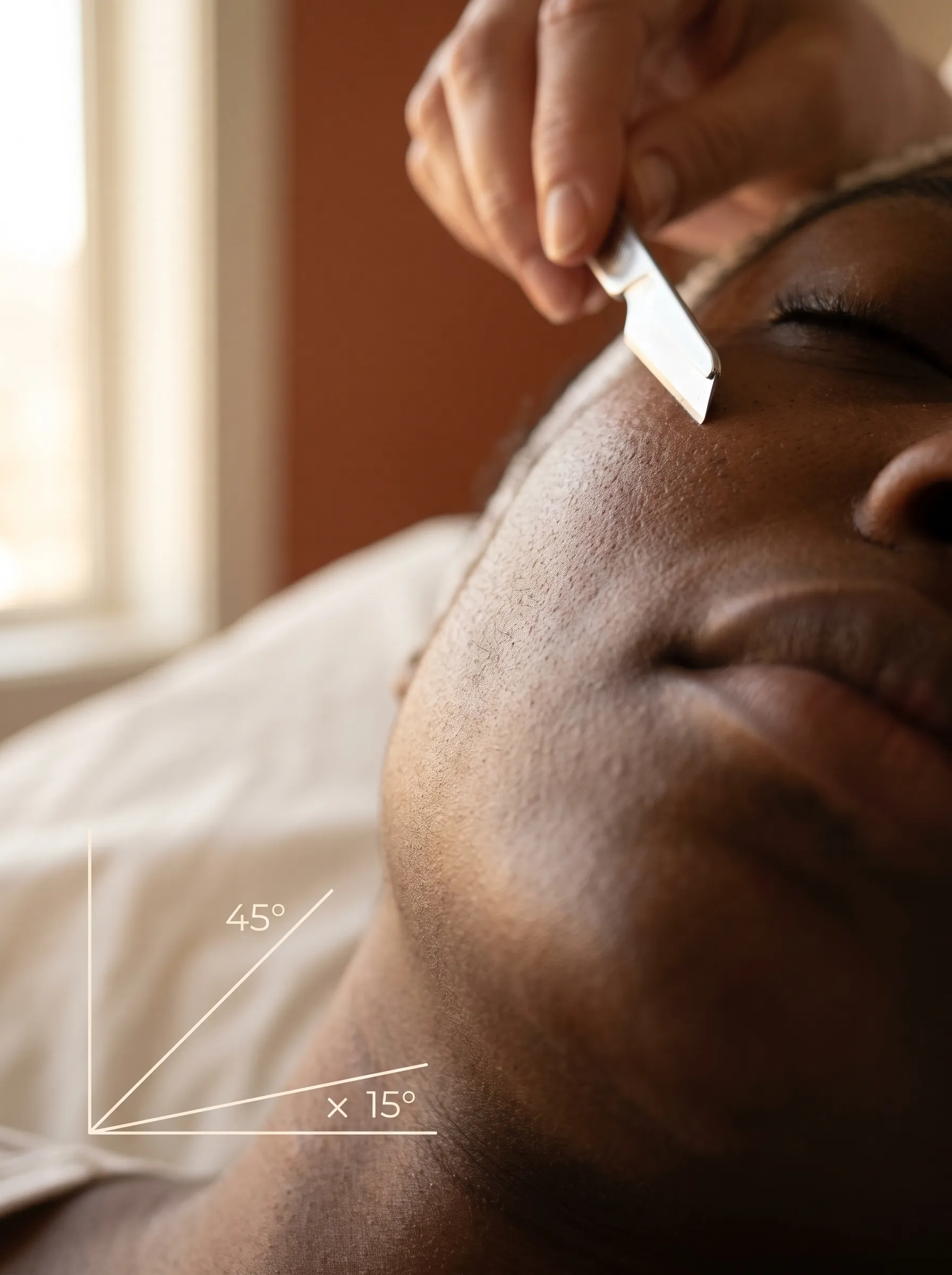
Most people searching for dermaplaning in San Diego have the same question underneath it: is this safe for my skin? The answer depends less on the treatment than on the provider. Dermaplaning removes dead surface cells and fine vellus hair using a sterile surgical blade. On melanin-rich skin, the version of that sentence that matters is this: the blade does not decide the outcome. The technique does.
Is dermaplaning safe on melanin-rich skin?
Dermaplaning is safe on melanin-rich skin when the blade angle and pressure are correct. It uses no heat and no acid — the two main triggers for post-inflammatory pigmentation.
The safety distinction matters because melanin-rich skin responds to injury differently. When melanocytes are triggered by inflammation, they overproduce pigment — a well-documented mechanism covered in the Journal of Clinical and Aesthetic Dermatology review of PIH in skin of color. Dermaplaning carries no heat and no chemical load, which removes the two most common triggers for that response.
The dermaplane facial at KIAMO SKIN is performed by a licensed esthetician on a dry surface, section by section, with active or inflamed areas worked around rather than over.
What makes dermaplaning risky, and what removes that risk?
Blade angle and pressure are the two variables. At 45 degrees with light, even strokes, the blade lifts dead cells cleanly. Lower angle or heavier pressure creates micro-injury — that injury triggers pigmentation.
The stratum corneum — the outermost layer of dead cells — sits above the living tissue. The blade is designed to skim it. When the angle drops too low or pressure increases, the pass creates micro-injury at the dermal layer. That injury signals inflammation, and inflammation is what triggers pigment production in melanin-rich skin.
Thickness varies across the face. Skin along the jawline and cheekbones is naturally thicker; skin at the upper lip and over bony prominences is thinner. An esthetician who works with melanin-rich skin as the whole practice adjusts the approach by zone rather than treating the entire face identically.
Are estheticians allowed to dermaplane in California?
Yes. Since January 1, 2022, California law permits licensed estheticians to perform dermaplaning. A California Board of Barbering and Cosmetology licence is the correct credential.
This matters practically, not just legally. A licence requires training on contraindications, blade handling, and skin response. At-home tools and unlicensed providers operate without that structure — the blade angle is uncontrolled, the skin is not assessed beforehand, and there is no professional judgment about whether the treatment is appropriate that day. The California Board industry bulletin is the authoritative source on this.
Kiki holds a California Board of Barbering and Cosmetology licence with five years of practice in corrective skin work. Appointments are one-to-one, by request, in a single private studio in Mission Hills. The first visit includes a skin assessment before any treatment is applied.
Can dermaplaning cause hyperpigmentation on dark skin?
It can — but only when technique causes inflammation. The blade itself does not trigger pigment. Inflammation does, and melanin-rich skin responds to inflammation by producing more pigment.
Temporary redness after dermaplaning is normal and resolves within a few hours — this is superficial vascular response, not melanocyte activity. Post-inflammatory hyperpigmentation is different: it develops over days and produces brown or grey discoloration where inflammation occurred. According to the American Academy of Dermatology, spots a few shades darker than surrounding skin typically take six to twelve months to fade without treatment, and deeper pigment can take longer.
If you have active acne or inflamed breakouts, dermaplaning is worked around those areas or the appointment rescheduled. Passing a blade over an active pustule creates the inflammation that produces a mark. The treatment is not the problem — applying it over the wrong skin at the wrong time is.
If you have existing post-inflammatory marks or melasma, dermaplaning does not address those directly. A prepared Lira peel series works at the cellular level to clear pigmentation. Dermaplaning maintains the surface between peel appointments and improves serum absorption, but it does not clear existing marks on its own.
Dermaplaning or a chemical peel — which one is right for dark skin?
They do different things. Dermaplaning removes dead surface cells without chemicals. A peel works on pigmentation and marks at a cellular level. Most melanin-rich skin plans use both.
| Dermaplaning | Chemical peel | |
|---|---|---|
| What it treats | Surface texture, dullness, peach fuzz, product absorption | PIH, melasma, uneven tone, acne marks |
| How it works | Blade removes dead cells at the surface | Acid resurfaces below the surface |
| Heat or chemical exposure | None | Acid — strength matched to your skin on the day |
| PIH risk on dark skin | Low when technique is correct | Higher if unprepared or too strong |
| Best use | Maintenance, event prep, between peel appointments | Corrective series over multiple visits |
| At KIAMO SKIN | $199 | $199 Gentle Renewal · $299 Advanced |
If your goal is smoother texture, better absorption, or skin that looks clearer before an event, dermaplaning is the right starting point. If your goal is clearing post-inflammatory marks or managing melasma, that is done with a prepared peel series over multiple visits with home prep in between.
Understanding which kind of pigmentation you have is the step that decides which treatment comes first. A dermaplaning session is often used between peel appointments to maintain the cleared surface and improve topical absorption.
Does peach fuzz grow back different after dermaplaning on dark skin?
No. The blade removes hair at the skin surface, not at the follicle. Vellus hair grows back exactly as it was — same texture, same colour.
The concern comes from confusing dermaplaning with shaving. Shaving cuts the hair shaft mid-length, leaving a blunt tip that feels coarser as it grows back. Dermaplaning removes the entire visible hair above the surface. The follicle — which determines all hair characteristics — is never touched. What happens above the skin cannot change what the follicle produces.
This is a frequent question from Black and brown clients: will dermaplaning change the texture of my facial hair? The answer is no. Vellus hair on the face is fine by nature, regardless of the coarser or curlier terminal hair elsewhere. The follicles are structurally different and dermaplaning does not interact with either type at the root.
Who should not get dermaplaning?
Active acne, a broken barrier, active rosacea, open skin, and isotretinoin use are all contraindications. Those areas are skipped or the appointment rescheduled.
On melanin-rich skin, timing matters as much as candidacy. A reactive barrier — stinging after cleansing, flushing easily, tight without moisturiser — is not ready for a surface treatment. That condition is rebuilt first. DMK Enzyme Therapy is the protocol for compromised barrier work at this studio. Dermaplaning follows once the skin is stable, not before.
If you are in an active breakout phase, treating the acne comes first. Every active spot passed over with a blade is a potential PIH site.
How much does dermaplaning cost in San Diego?
The Dermaplane Facial at KIAMO SKIN is $199, performed by a licensed esthetician in Mission Hills, San Diego.
Dermaplaning in San Diego ranges from roughly $80 to $200 depending on provider type and what is included. At KIAMO SKIN the $199 treatment is a full facial — cleanse, dermaplane, treatment serums while absorption is at its highest, and SPF to close. Published prices are unusual in this market. What is listed here is verified, not approximate.
The studio is in Mission Hills, five minutes from Hillcrest, Bankers Hill and Little Italy, with free parking. Clients travel from across San Diego County—North Park clients are ten minutes away with no freeway, while coastal areas like Pacific Beach and La Jolla are fifteen to twenty minutes. That proximity makes regular dermaplaning between peel appointments realistic rather than aspirational. Appointments are request-based. San Diego's UV index runs 8 to 10 from April through October—freshly dermaplaned skin has a temporarily reduced surface barrier, and applying SPF before you leave is part of the service. The June Gloom piece covers why that applies even on overcast San Diego mornings.
Written by Kiki, Licensed Esthetician, California Board of Barbering & Cosmetology, with 7+ years treating melanin-rich skin at KIAMO Skin in Mission Hills, San Diego.
Common questions
Dermaplaning questions
Is dermaplaning safe for Black skin?
Can dermaplaning cause PIH on darker skin tones?
Does peach fuzz grow back thicker after dermaplaning on dark skin?
Are estheticians legally allowed to dermaplane in California?
How much does a dermaplaning facial cost in San Diego?
Who should avoid dermaplaning?
Do people regret dermaplaning, and what usually goes wrong?
Also in the journal
Three kinds of dark mark, and why one facial cannot fix all three
Choosing a facial for hyperpigmentation before you know which kind you have is the most common reason treatment fails — and occasionally the reason it backfires.
June gloom is not sun protection
The marine layer is the single most expensive misunderstanding in San Diego skincare. It looks like cover. It is not cover.
San Diego hard water and your scalp
If your scalp flakes, itches, or feels coated no matter what shampoo you buy, the shampoo may not be the variable worth changing.
Microneedling on dark skin, and why depth decides the outcome
The question is not really whether needling works on melanin-rich skin. It is whether the person holding the device has set the depth for the skin in front of them.
Professional Scalp Treatment San Diego: Keravive for Dandruff, Flaking & Hair Health
Looking for professional scalp treatment in San Diego? KIAMO SKIN offers Keravive therapy for dandruff, seborrheic dermatitis, dry scalp, and hair thinning. While over-the-counter shampoos treat surface symptoms, Keravive addresses the root cause.
San Diego Scalp Treatments: How Does Keravive Work?
Keravive is a clinical scalp treatment designed to remove years of product buildup, hard water minerals, and oil congestion that shampoo can't reach. For San Diego residents dealing with ocean humidity, hard water, and year-round sun exposure, it addresses the root causes of flaking, tightness, and hair thinning.
Hyperpigmentation Treatment Guide: What Actually Works for Dark Spots, Melasma & PIH
If you have struggled with stubborn dark spots, melasma, or uneven skin tone in San Diego, the right combination of professional treatments and medical-grade home care can produce dramatic improvement—but only if the approach is calibrated for your skin tone and pigmentation type.
How much does a chemical peel cost in San Diego?
The price of a chemical peel in San Diego varies by depth, formulation, and whether it is part of a treatment series — but the more important question is which one your skin actually needs.