Dermaplaning or a chemical peel: which one actually changes your skin?
The two sound like competing versions of the same thing and are not. One removes what is sitting on top of the skin; the other changes what happens underneath it.
Dermaplaning and a chemical peel work on different layers. Dermaplaning uses a sterile blade to remove dead surface cells and vellus hair — no heat, no acid, no downtime — which makes it the right choice for texture, peach fuzz and product absorption. A chemical peel puts acid on the skin so that the upper layers resurface over the following days, which makes it the right choice for brown patches and post-inflammatory marks. On melanin-rich skin the peel carries the higher risk of making pigment worse, so it is run as a prepared, escalating series. At KIAMO Skin in San Diego, dermaplaning is $199 and Lira peels are $199 for Gentle Renewal and $299 for Advanced.
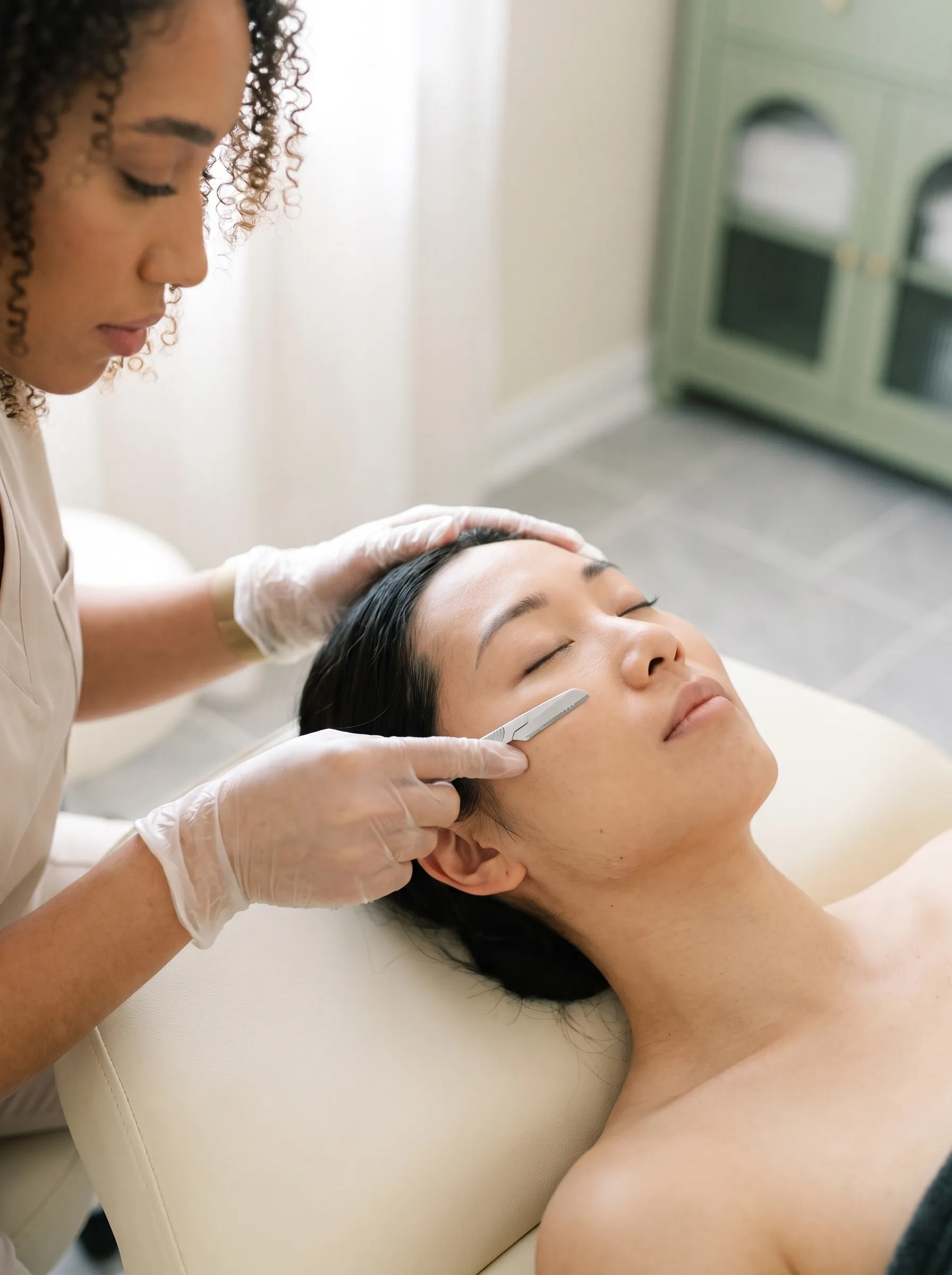
Two treatments get booked under the same expectation: smoother, brighter skin by the end of the month. The two do not deliver the same thing. One is a controlled removal of the surface layer. The other is a chemical process that changes what happens in the upper layers of skin over the days that follow. Clients who pick the wrong one for the concern usually end up disappointed for reasons that have nothing to do with the quality of the treatment.
The short answer
Dermaplaning removes dead surface cells and vellus hair with a sterile blade, and nothing else. A chemical peel applies acid to the skin so that the upper layers resurface over the days that follow. Texture, peach fuzz and product absorption are dermaplaning problems. Brown patches, post-inflammatory marks and uneven tone are peel problems. Most people who think a peel is the answer actually need the surface cleared first.
The reason the two get confused is that both produce visible change, and both produce it within about a week of the appointment. What changed underneath is a different question, and it is the question a consultation actually answers.
What dermaplaning actually does
Dermaplaning takes the dead surface layer and the fine vellus hair sitting on top of it off the skin. That is the entire treatment. It does not dissolve pigment, does not stimulate collagen, and does not reach below the stratum corneum.
The practical consequence is a face that takes product better. With the debris removed, serums land on live tissue rather than on a layer of dead cells, and makeup stops catching on hair and texture. The dermaplane facial at KIAMO Skin is a cleanse, a blade pass over dry skin, treatment serums while absorption is highest, and SPF to close.
- The skin is cleansed and taken completely dry. Dermaplaning is performed on a dry surface, because residual moisture changes how the blade sits.
- The blade is held at a fixed angle and drawn across the skin in short, controlled strokes, section by section. Active or pustular acne is worked around rather than over.
- Serums go on next, while absorption is at its peak, and the treatment closes with SPF.
- There is no heat and no acid, which is exactly why the risk profile on melanin-rich skin is so different from a peel.
What a chemical peel actually does
A chemical peel places acid on the skin, and the acid does controlled damage to the upper layers so that the skin resurfaces. The result is not a removal — it is a turnover. Pigment sitting in those layers comes away with the turnover, which is why peels work on discolouration and dermaplaning does not.
This is where the risk sits, particularly for deeper skin tones. A systematic review of PIH treatment in skin of colour found that chemical peels accounted for 20% of trauma-induced post-inflammatory hyperpigmentation cases in its dataset, and that after two weeks of salicylic acid peels, 40% of patients showed new hyperpigmentation. The same review concluded that peels should not be used routinely as a first-line treatment in that population, but may have merit in refractory cases.
That is why peels here run as a prepared Lira peel series rather than a single strong appointment: lower strength first, escalation every four to six weeks, and daily sun protection as a condition of the plan. Safe chemical peel practice begins with professional evaluation and matching the peel to the skin in front of you.
Which one for which concern
| Dermaplaning | Chemical peel | |
|---|---|---|
| What it targets | Surface texture, vellus hair, dullness, product absorption | Pigment, uneven tone, post-inflammatory marks |
| How it works | A blade removes the dead surface layer | Acid resurfaces the upper layers over several days |
| Heat or acid | Neither | Acid, with strength matched to the skin on the day |
| Depth | The stratum corneum only | The upper layers, and how far depends on strength |
| Results arrive | In the room, and hold until the surface builds again | Over the days after, and build across a series |
| Best on melanin-rich skin | Low risk, because there is no inflammation to trigger pigment | Workable, but only as a prepared, escalating series |
Read down the rows and the split becomes obvious. If the complaint is how the skin feels and how products sit on it, dermaplaning is the answer. If the complaint is the colour, the peel is the answer. Very few people have only one of those complaints, which is why the pairing comes up so often.
What it costs and what the recovery looks like
| Dermaplaning | Chemical peel | |
|---|---|---|
| Cost | $199 for the full facial | $199 for Gentle Renewal, $299 for Advanced |
| Appointments needed | One | A series, spaced every four to six weeks |
| Downtime | None. A light flush, and you are out | A day or two of visible peeling, depending on strength |
| Social calendar | Book it before an event | Book it with a couple of quiet days afterwards |
| Sun sensitivity after | Mild — the treatment closes with SPF | Higher — daily SPF is a condition of the plan |
| Keeping the result | Every few weeks, or before events | Home care between appointments holds it |
The chemical peel cost breakdown covers the full price list in more detail, and it is worth reading before committing to a series rather than after the first appointment.
Can you have both in the same visit?
Yes, and pairing the two is often the most efficient option. Dermaplaning clears the surface first, and the peel then reaches the upper layers more evenly because there is no layer of dead cells in the way. The studio frequently pairs the two for exactly this reason.
The order is not interchangeable. Surface first, acid second — never the reverse, because acid on an uncleared surface is uneven acid. And the timing between a standalone dermaplane and a peel series matters too: dermaplaning on freshly peeled skin is too much for one appointment.
When neither is the right call
When the concern sits deeper than either treatment reaches. Deep dermal pigment, melasma that has not responded to a prepared series, and scarring that has changed the texture of the skin all need a dermatologist rather than an esthetician.
This is a facial spa. There is no laser here and no prescription-strength medication, and any client whose concern sits below what a surface treatment and a controlled peel can address is better served by a dermatologist. Saying so is more useful than selling a series that will not reach the depth involved. The three kinds of dark mark journal piece is a good first step for working out which category a concern falls into before booking either treatment.
Why asking a studio that does both is the honest way to decide
Because a provider who only sells one of these has a commercial reason to recommend it and no way to mention the other. A provider who performs both, and who can also say when neither is appropriate, is giving an answer rather than a sales pitch.
It is also why the consultation at KIAMO Skin starts with the skin rather than the treatment. What shows up at the appointment — the texture, the pigment depth, the barrier state, the active breakouts, the recent sun exposure — decides which protocol runs and in what order. The same client can need dermaplaning alone in March and a peel series by July, and the reverse a year later.
What most San Diego clients end up doing
The most common plan is a peel series for the pigment, with dermaplaning between appointments to keep the surface clear so that home care absorbs properly and the next peel lands on an even surface. The second most common is dermaplaning alone, before an event, with a peel series discussed separately once the client is ready for the commitment.
One note specific to San Diego: June gloom is not sun protection. The overcast months remove the warmth people use to judge risk while letting a large share of ultraviolet through, and a peel plan that does not take daily light protection seriously will not hold its result. That is true of both treatments, and it is why both close with SPF.
Questions worth asking before booking either one
- Is the concern texture or colour? Those need different treatments, and naming one as the priority is worth doing out loud.
- What happens to the barrier in the days afterwards, and what does the aftercare look like?
- Is this a one-off appointment or the first of a series, and what does the series cost?
- What is the plan if the treatment makes pigment worse rather than better?
Written by Kiki, Licensed Esthetician, California Board of Barbering & Cosmetology, with 7+ years treating melanin-rich skin at KIAMO Skin in San Diego.
Common questions
Dermaplaning and chemical peel questions
Which is better for sun damage: dermaplaning or a chemical peel?
Can you have dermaplaning and a chemical peel in the same visit?
Which one has more downtime?
Is it worth booking both, or should you pick one?
What is the difference between exfoliating at home and dermaplaning in a studio?
Also in the journal
Three kinds of dark mark, and why one facial cannot fix all three
Choosing a facial for hyperpigmentation before you know which kind you have is the most common reason treatment fails — and occasionally the reason it backfires.
June gloom is not sun protection
The marine layer is the single most expensive misunderstanding in San Diego skincare. It looks like cover. It is not cover.
San Diego hard water and your scalp
If your scalp flakes, itches, or feels coated no matter what shampoo you buy, the shampoo may not be the variable worth changing.
Microneedling on dark skin, and why depth decides the outcome
The question is not really whether needling works on melanin-rich skin. It is whether the person holding the device has set the depth correctly for the skin in front of the device.
Is dermaplaning safe for dark skin? Here is what actually matters.
The question is not really whether dermaplaning works on darker skin. It is whether the blade angle and pressure match the skin in front of it.
Professional Scalp Treatment San Diego: Keravive for Dandruff, Flaking & Hair Health
Looking for professional scalp treatment in San Diego? KIAMO Skin offers Keravive therapy for dandruff, seborrheic dermatitis, dry scalp, and hair thinning. While over-the-counter shampoos treat surface symptoms, Keravive addresses the root cause.
San Diego Scalp Treatments: How Does Keravive Work?
Keravive is a clinical scalp treatment designed to remove years of product buildup, hard water minerals, and oil congestion that shampoo can't reach. For San Diego residents dealing with ocean humidity, hard water, and year-round sun exposure, it addresses the root causes of flaking, tightness, and hair thinning.
Hyperpigmentation Treatment Guide: What Actually Works for Dark Spots, Melasma & PIH
If you have struggled with stubborn dark spots, melasma, or uneven skin tone in San Diego, the right combination of professional treatments and medical-grade home care can produce dramatic improvement—but only if the approach is calibrated for your skin tone and pigmentation type.
How much does a chemical peel cost in San Diego?
The price of a chemical peel in San Diego varies by depth, formulation, and whether it is part of a treatment series — but the more important question is which one your skin actually needs.
Best chemical peel for melasma, and what the answer actually depends on
"Best peel for melasma" is a search query, not a clinical answer. The right peel is the one your Fitzpatrick type can tolerate every four to six weeks, repeated across a series, with melanin production quieted between sessions.
Acne scars in San Diego: which ones a facial can fix and which need microneedling
Most of the time when a facial "didn't work" for acne scarring, the scar type was never the issue. The treatment was.
Best sunscreen for dark spots in San Diego: what to look for on the label
Most sunscreen in San Diego is bought on brand and worn on habit. For a mark that keeps coming back, the label matters more than the name on the front.
How much does a facial cost in San Diego in 2026?
The published San Diego market rate for a facial spans a wide range, and the gap between the two ends of it is not quality — it is what the price includes. First-time clients here start at $249.