Journal · 12 min read
Professional Scalp Treatment San Diego: Keravive for Dandruff, Flaking & Hair Health
Looking for professional scalp treatment in San Diego? KIAMO SKIN offers Keravive therapy for dandruff, seborrheic dermatitis, dry scalp, and hair thinning. While over-the-counter shampoos treat surface symptoms, Keravive addresses the root cause.
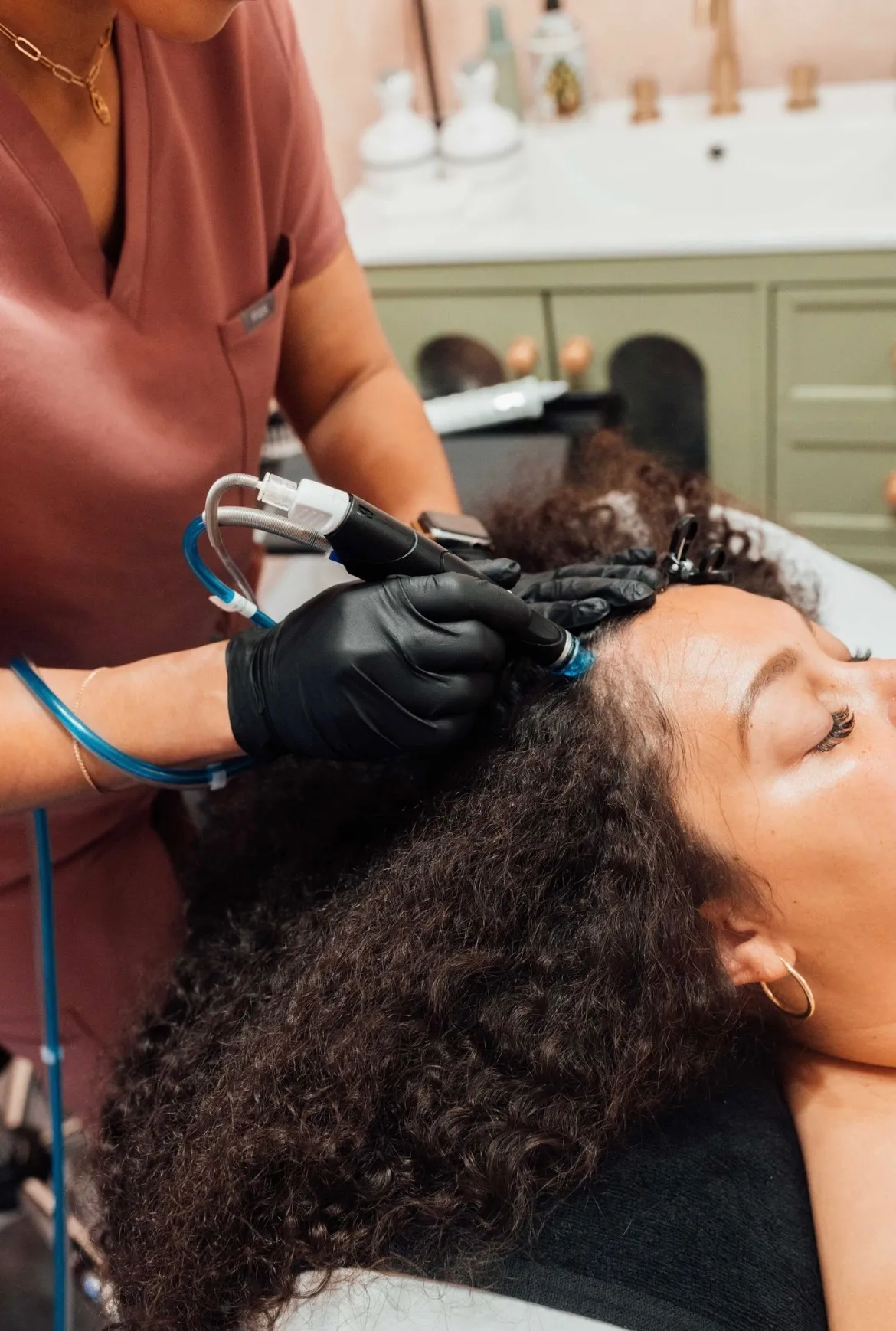
Looking for professional scalp treatment in San Diego? If you've been rotating through Head & Shoulders, Nizoral, and Selsun Blue for months and still see flakes, the problem isn't the shampoo you chose. Over-the-counter shampoos treat surface symptoms. Professional Keravive scalp therapy at KIAMO SKIN addresses the root cause: buildup, congestion, and inflammation below the surface that at-home products simply can't reach.
Why San Diego residents need professional scalp treatment
San Diego's environment creates unique scalp challenges that over-the-counter products can't fully address. Hard water, year-round sun exposure, ocean salt, and dry inland climate all contribute to scalp issues that require professional intervention.
Living in San Diego means your scalp deals with conditions that accelerate buildup and inflammation:
- Some of California's hardest water. San Diego's tap water contains high levels of calcium and magnesium that deposit on your scalp with every shower, creating a layer of mineral buildup that traps oils, clogs follicles, and mimics dandruff. Medicated shampoos can't dissolve these deposits.
- Year-round UV exposure. San Diego averages 266 sunny days per year. Chronic sun exposure on your scalp triggers inflammation and accelerates cell turnover, leading to increased flaking and sensitivity.
- Ocean and beach lifestyle. Salt spray from the coast (even inland areas like Mission Hills), chlorine from pools, and sand particles all contribute to scalp congestion. For residents in Pacific Beach, La Jolla, and Del Mar, this is a daily reality.
- Dry inland climate. Areas like Mission Valley, North Park, and Carlsbad experience low humidity, which causes scalp dryness that's often mistaken for dandruff. Moisturizing shampoos provide temporary relief but don't restore the scalp barrier.
These environmental factors combine to create scalp issues that standard products can't fix. Professional scalp treatment removes years of accumulated buildup in a single session--something no at-home routine can achieve.
This guide explains what causes dandruff, how to treat it at home, and when professional scalp therapy becomes the only solution that works. If you live in San Diego, there's an additional factor making your dandruff worse--and most dermatologists never mention it.
What causes dandruff?
Dandruff is caused by a combination of oil production, a yeast called Malassezia, and how quickly your scalp sheds dead skin cells. Malassezia lives on everyone's scalp, but some people's immune systems react to it, triggering inflammation and rapid cell turnover that shows up as visible flakes. In San Diego, hard water mineral buildup can make the problem worse by creating additional scalp irritation that mimics or compounds dandruff symptoms.
The yeast feeds on sebum, which is why people with oilier scalps tend to have more severe dandruff. When Malassezia breaks down sebum, it produces oleic acid--a byproduct that irritates the scalp and accelerates the shedding process. That's why dandruff isn't just about dryness. You can have an oily scalp and still see flakes.
Hormones, stress, cold weather, and immune system changes all influence how much your scalp reacts to Malassezia. That's why dandruff often gets worse in winter or during periods of high stress--your scalp's inflammatory response intensifies, and cell turnover speeds up even more.
San Diego's climate adds another layer. The city's hard water--among the hardest in California--leaves calcium and magnesium deposits on your scalp every time you wash your hair. Over time, that mineral buildup creates a layer of residue that traps oil, dead skin, and styling products, making it harder for medicated shampoos to work. At KIAMO Skin in Mission Hills, we see this constantly: clients come in after trying every shampoo at CVS, only to discover their scalp was covered in hard water buildup, not dandruff.
How do I know if my dandruff is fungal or dry scalp?
Fungal dandruff (seborrheic dermatitis) shows as greasy, yellowish flakes with redness and often intense itching, while dry scalp produces small, white flakes without much oil. If moisturizing makes it worse or anti-dandruff shampoo doesn't help after 2 weeks, you're likely dealing with seborrheic dermatitis rather than simple dryness.
Here's how to tell them apart:
- Dry scalp: Small, white flakes that fall easily. Scalp feels tight or itchy, especially after washing. Moisturizing helps. Often worse in winter or low-humidity environments.
- Fungal dandruff: Larger, greasy flakes that stick to hair. Scalp looks red or inflamed. Itching is persistent. Flakes may have a yellowish tint. Worsens with oil or heavy conditioners.
Seborrheic dermatitis often appears in other areas beyond the scalp--eyebrows, sides of the nose, behind the ears, or along the hairline. If you're seeing flaking in multiple zones, it's not dry scalp. It's an inflammatory condition that requires a different treatment approach.
One quick test: if your scalp feels better after using a zinc pyrithione or ketoconazole shampoo, you're dealing with fungal dandruff. If it only improves with hydration and gets worse with medicated shampoos, it's dryness.
What kills dandruff quickly?
Over-the-counter shampoos with zinc pyrithione, ketoconazole, selenium sulfide, or salicylic acid can reduce visible flakes within 1-2 weeks when used correctly. The key is leaving the lather on your scalp for 5 minutes before rinsing, not just washing and rinsing immediately--most people skip this step and wonder why nothing works.
Medicated shampoos work by targeting different parts of the dandruff cycle. Some slow down Malassezia growth, others reduce inflammation, and some help lift away the buildup of dead cells that creates visible flakes. But they all require contact time. If you apply the shampoo, scrub, and rinse in under a minute, the active ingredients never penetrate the scalp.
Here's the process that actually works:
- Wet your hair thoroughly. Hard water in San Diego means you need more time and heat to open the cuticle and let active ingredients in.
- Apply medicated shampoo directly to your scalp, not your hair. Massage it into the skin in circular motions.
- Leave it on for 5 minutes. Set a timer. This is when the active ingredients work.
- Rinse completely. Residue left behind can cause more irritation.
- Repeat 2-3 times per week until flakes clear, then reduce to once or twice weekly for maintenance.
If one active ingredient stops working after a few months, switch to a shampoo with a different mechanism--your scalp can adapt to a single treatment, but rotating between two types keeps it effective.
What are the best at-home dandruff treatments?
| Active Ingredient | What It Does | Best For | How to Use | Examples |
|---|---|---|---|---|
| Zinc Pyrithione | Reduces yeast and bacteria on the scalp | Mild to moderate dandruff, all hair types | 2-3x per week, leave on 3-5 minutes | Head & Shoulders, Dove DermaCare |
| Ketoconazole 1-2% | Antifungal; targets <em>Malassezia</em> directly | Severe dandruff, seborrheic dermatitis | 2x per week, leave on 5 minutes | Nizoral A-D |
| Selenium Sulfide | Slows scalp cell turnover, fights yeast | Stubborn dandruff, oily scalp | 2x per week, leave on 5 minutes, rinse thoroughly | Selsun Blue |
| Salicylic Acid | Exfoliates and removes crusty scale buildup | Thick, crusty flakes; scalp psoriasis | 2-3x per week, may cause dryness--follow with conditioner | Neutrogena T/Sal |
| Coal Tar | Slows cell turnover, reduces inflammation | Scalp psoriasis, very thick dandruff | 1-2x per week, strong smell, can darken light hair | Neutrogena T/Gel |
Rotation strategy: If your dandruff improves then comes back after a few months, alternate between two different active ingredients--for example, zinc pyrithione on Monday and Thursday, ketoconazole on Sunday. This prevents your scalp from adapting to one treatment.
For textured or dry hair: You don't need to shampoo your entire head 2-3 times per week. Apply the medicated treatment only to your scalp, let it sit, then rinse. Follow with a moisturizing conditioner on your hair strands, avoiding the scalp.
Why do I still have dandruff even after washing my hair?
If you're washing daily and still see flakes, you're either not using a medicated shampoo, not leaving it on long enough, or dealing with a condition that mimics dandruff like seborrheic dermatitis or psoriasis. San Diego's hard water can also leave mineral deposits that look like flakes even when dandruff is controlled.
At KIAMO Skin in Mission Hills, we see this constantly--clients come in after trying every shampoo at CVS, only to discover their scalp was covered in hard water buildup, not dandruff. When we perform the Keravive scalp treatment, the vacuum extraction pulls out white and yellow residue that's been sitting there for months. That buildup prevents medicated shampoo from reaching your actual scalp, which is why the flakes never fully go away.
Other reasons shampoo stops working:
- You're not treating the cause. Regular shampoo removes surface flakes but doesn't address the yeast, oil, or inflammation causing them. You need a medicated formula with an active ingredient.
- Product buildup is blocking treatment. Dry shampoo, styling gels, leave-in conditioners, and even silicone-heavy shampoos create a layer on your scalp that traps oil and dead skin. Medicated shampoo can't penetrate that barrier.
- You're actually dealing with seborrheic dermatitis or psoriasis. These are inflammatory scalp conditions that require prescription treatment or professional care. Over-the-counter shampoo helps, but it won't fully clear the problem.
- Your scalp pH is off. Hard water raises scalp pH, which makes it easier for Malassezia to thrive. An apple cider vinegar rinse (1 part vinegar to 4 parts water) can help rebalance it--but won't remove mineral buildup already there.
If you've been using medicated shampoo correctly for 4 weeks and still see flakes, it's time to escalate.
What is commonly mistaken for dandruff?
Seborrheic dermatitis, scalp psoriasis, eczema, and product buildup all produce flakes that look like dandruff but don't respond to typical dandruff shampoos. If you also have flaking eyebrows, behind your ears, or along your hairline, you're likely dealing with seborrheic dermatitis rather than simple dandruff.
| Condition | What It Looks Like | Where It Shows Up | How It Feels |
|---|---|---|---|
| Dandruff | White or light yellow flakes, loose and dry | Scalp only | Mild itching, worse when hair is oily |
| Seborrheic Dermatitis | Greasy, yellowish flakes; red, inflamed skin | Scalp, eyebrows, sides of nose, behind ears, chest | Intense itching, burning, or stinging |
| Scalp Psoriasis | Thick, silvery scales; well-defined red patches | Scalp (often at hairline), elbows, knees | Tight, sore, sometimes bleeding when scratched |
| Scalp Eczema | Dry, cracked skin; flakes mixed with oozing or crusting | Scalp, neck, behind ears | Severe itching, worsens with scratching |
| Product Buildup | White flakes that feel waxy or sticky | Scalp, especially near part lines | Scalp feels heavy or greasy even after washing |
Seborrheic dermatitis is the most common dandruff mimic. It's essentially severe dandruff--same yeast, same inflammation, but the immune response is stronger. Over-the-counter ketoconazole shampoo often helps, but prescription treatments may be needed.
If you're seeing thick, adherent scales that don't budge with regular shampooing, or if your scalp is painful or bleeding, see a dermatologist. These are signs of psoriasis or eczema, not dandruff.
When should I see a professional for dandruff?
See a dermatologist or licensed esthetician if over-the-counter treatments haven't worked after 4 weeks, if your scalp is severely inflamed or painful, or if you're losing hair along with the flaking. Professional scalp treatments can remove the buildup that shampoo can't reach.
Here's when to escalate:
- Medicated shampoo didn't work after a month of correct use. If you've been leaving zinc pyrithione or ketoconazole on your scalp for 5 minutes, 2-3 times per week, for 4 weeks, and you still see flakes, the problem is deeper than what shampoo can fix.
- Your scalp is red, swollen, or painful. This suggests seborrheic dermatitis, psoriasis, or a secondary infection. You need a professional diagnosis.
- You're losing more hair than usual. Chronic scalp inflammation can weaken hair follicles and increase shedding. Treating the scalp condition can help slow hair loss.
- Flaking comes with intense itching that disrupts your sleep or daily life. This is a quality-of-life issue that deserves professional intervention.
- You've tried multiple active ingredients and nothing holds. Your scalp may have become resistant to over-the-counter treatments.
The Keravive scalp treatment at KIAMO removes years of product, oil, and mineral buildup in a single session--something no at-home shampoo can do. Clients from La Jolla to Carlsbad come in after their dermatologist prescribed medicated shampoo that didn't solve the underlying scalp congestion. Once the buildup is cleared, medicated shampoo actually works again.
What is professional scalp treatment for dandruff?
Professional scalp therapy uses clinical-grade exfoliation and hydration to address the root cause--clogged follicles, oil imbalance, and chronic inflammation--rather than just treating surface flakes. HydraFacial Keravive is a 3-step process that cleanses, exfoliates, and infuses peptides into the scalp, similar to how a HydraFacial works on facial skin.
Step 1: Cleanse
A specialized vortex tip removes oil, dead skin, product buildup, and hard water mineral deposits from the scalp. This isn't a massage or a scrub--it's vacuum extraction. The device physically lifts out congestion that's been sitting there for months.
In San Diego, we consistently see white and yellow buildup in the extraction canister, even from clients who wash their hair daily. That's calcium, magnesium, styling product, sebum, and dead skin--all layered together in a way that shampoo can't touch.
Step 2: Nourish
A concentrated peptide complex is infused into the scalp to support a healthier environment for healthy hair growth. The peptides help calm inflammation, improve circulation, and nourish the follicles.
This step is what differentiates Keravive from a clarifying shampoo. Once the buildup is removed, the scalp is primed to absorb active ingredients. The peptide serum goes directly into clean follicles, not onto a layer of residue.
Step 3: Continue at home
Every Keravive treatment includes a take-home peptide spray to nourish the scalp between visits. Consistency is what holds the result--one deep cleanse clears the congestion, but regular maintenance keeps it from coming back.
Pricing at KIAMO Skin:
- Single Keravive Scalp Treatment: $599
- 3-Treatment Series: $1,499 (recommended for chronic buildup or inflammatory scalp conditions)
Who benefits from Keravive?
- Chronic dandruff that doesn't respond to medicated shampoo. If you've tried zinc pyrithione, ketoconazole, and selenium sulfide with no improvement, buildup is likely blocking the active ingredients from reaching your scalp.
- San Diego residents dealing with hard water damage. If your scalp feels tight, itchy, or flaky even after shampooing, mineral deposits are likely the problem.
- Anyone who invests in skincare but has never treated their scalp. Your scalp is skin. If you're getting monthly facials but ignoring your scalp, you're missing a major source of congestion and inflammation.
- People experiencing increased shedding with visible scalp buildup. A congested scalp creates a poor environment for healthy hair growth.
Tara K., who drives in from Del Mar, said: "Made the trip from Del Mar after race season and my skin texture was completely different by the third Procell session. The scalp work was the surprise bonus."
Bree A., from Carlsbad, added: "Coming from Carlsbad I blocked off the whole morning. We did Procell and Keravive back-to-back and it made every long drive worthwhile."
Keravive isn't a luxury scalp spa treatment--it's corrective therapy for a scalp that standard products can't fix. Book a Keravive consultation at KIAMO Skin in Mission Hills.
What happens if dandruff is left untreated?
Chronic dandruff can lead to persistent scalp inflammation, increased hair shedding, and secondary infections from constant scratching. While dandruff itself doesn't cause permanent hair loss, the inflammation and scratching it triggers can weaken hair follicles over time.
Here's what happens when dandruff goes unaddressed:
- Inflammation becomes chronic. The longer Malassezia colonizes your scalp, the more your immune system reacts. Chronic inflammation disrupts the hair growth cycle, pushing more follicles into the shedding phase prematurely.
- Scratching damages the scalp barrier. Constant scratching breaks the skin, creating entry points for bacteria. This can lead to folliculitis (infected hair follicles) or impetigo (a bacterial skin infection).
- Buildup thickens and hardens. Over months or years, oil, dead skin, and product residue form a dense layer on the scalp. This layer suffocates follicles, worsens itching, and makes the scalp harder to treat.
- Hair quality declines. A congested, inflamed scalp produces weaker hair. Strands may feel thinner, break more easily, or grow more slowly.
Dandruff won't make you bald, but it creates an environment where hair struggles. Treating it early--whether with medicated shampoo or professional scalp therapy--prevents the problem from escalating into something harder to reverse.
Written by Kiki, Licensed Esthetician, California Board of Barbering & Cosmetology, with 7+ years treating melanin-rich skin at KIAMO Skin in Mission Hills, San Diego.
Common questions
Dandruff Treatment Questions
Is it better to wash hair daily if I have dandruff?
Should you brush dandruff off?
Can dandruff be cured permanently?
Does San Diego water make dandruff worse?
Also in the journal
Three kinds of dark mark, and why one facial cannot fix all three
Choosing a facial for hyperpigmentation before you know which kind you have is the most common reason treatment fails — and occasionally the reason it backfires.
June gloom is not sun protection
The marine layer is the single most expensive misunderstanding in San Diego skincare. It looks like cover. It is not cover.
San Diego hard water and your scalp
If your scalp flakes, itches, or feels coated no matter what shampoo you buy, the shampoo may not be the variable worth changing.
Microneedling on dark skin, and why depth decides the outcome
The question is not really whether needling works on melanin-rich skin. It is whether the person holding the device has set the depth for the skin in front of them.
Is dermaplaning safe for dark skin? Here is what actually matters.
The question is not really whether dermaplaning works on darker skin. It is whether the blade angle and pressure match the skin in front of it.
San Diego Scalp Treatments: How Does Keravive Work?
Keravive is a clinical scalp treatment designed to remove years of product buildup, hard water minerals, and oil congestion that shampoo can't reach. For San Diego residents dealing with ocean humidity, hard water, and year-round sun exposure, it addresses the root causes of flaking, tightness, and hair thinning.
Hyperpigmentation Treatment Guide: What Actually Works for Dark Spots, Melasma & PIH
If you have struggled with stubborn dark spots, melasma, or uneven skin tone in San Diego, the right combination of professional treatments and medical-grade home care can produce dramatic improvement—but only if the approach is calibrated for your skin tone and pigmentation type.
How much does a chemical peel cost in San Diego?
The price of a chemical peel in San Diego varies by depth, formulation, and whether it is part of a treatment series — but the more important question is which one your skin actually needs.