What a decade on the peninsula does to a face
Point Loma is a peninsula, and clients come from both of its coastlines — Ocean Beach and Sunset Cliffs on the Pacific side, Shelter Island and Harbor Island across the bay. The Pacific side brings salt spray and year-round wind off the water. The bay side brings reflected ultraviolet light at midday, off a surface that is doing the same reflecting job the sand does at the beach. The wind is the underrated one. It strips the lipids that hold the barrier together, and skin that has been buffeted for years is skin that reacts to a product it used to tolerate.
The population matters as much as the climate. The neighborhoods around Rosecrans Street and the western tip are working, maritime and long-sun-exposed, and many of the clients who come to the studio are people who have been outdoors in this microclimate for decades rather than seasons. What that produces is not a single condition but an accumulation: a face with a history of ordinary skin injuries — a shaving nick, an ingrown hair, an acne episode that was never treated — each of which left a mark, sitting under a broad field of sun-driven uneven tone that accumulated slowly over the same period.
The result is what the service description calls uneven tone across the face with no single cause. It looks like one problem and it behaves like three, and that is the reason the first appointment here is not a peel. It is a sorting.
Why the marks have no single cause
Post-inflammatory hyperpigmentation is the skin's response to inflammation. It sits where the injury was, in the surface and mid-layers, and it runs deeper and lasts longer on melanin-rich skin, where melanin is produced readily in response to inflammation. That is the first kind of mark, and on Point Loma it is often the oldest and the most specific — a single dark patch, sharply localised, that has been there since an injury years ago.
The second is sun damage, and it does not behave like a mark at all. It is a field: uneven tone across the forehead, the cheekbones, the bridge of the nose and the ears, distributed by where the light actually lands. It is not one injury but several decades of the same exposure, and it responds to depth rather than to a spot.
The third is melasma — hormonal, and light-driven — which tends to arrive symmetrically across the upper lip, the cheeks and the forehead, often in later life as the hormonal picture shifts.
These three look alike from the doorway and behave differently underneath. A peel built for a spot applied across a field, or a peel built for a field applied to one stubborn mark, produces the flat, disappointing result that makes people say the treatment did not work. The three kinds of dark mark is the shortest useful read on the subject, and it is worth ten minutes before the first appointment.
The barrier comes first on this peninsula
The barrier work usually comes before the pigment work here, and the reason is the climate rather than the age of the client. Salt air and peninsula wind work together: the salt loosens the surface lipids and the wind takes what is left, and the rinse afterwards removes the oils that hold the barrier together. The result is skin that is tight by the afternoon, reactive to products it tolerated a year ago, and slow to settle after anything.
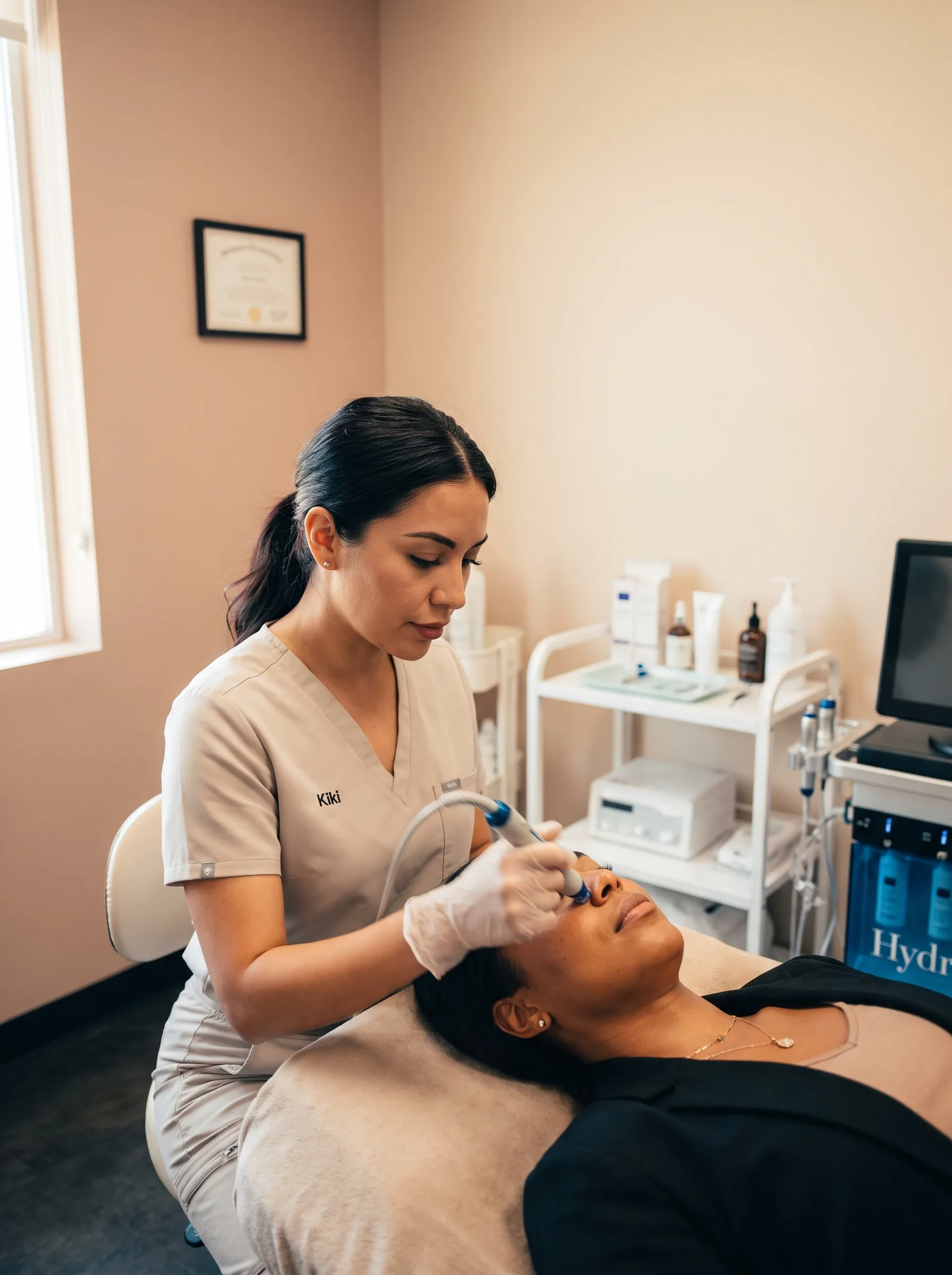
That state is not cosmetic. A peel is a controlled injury, and the inflammatory response it produces has to be resolvable by the skin it happened to. On a stripped barrier it often is not, and the pigment that follows is darker and more persistent than what was being treated. So the sequence usually starts with DMK enzyme therapy at $279, which rebuilds the condition and function of the skin rather than resurfacing it, and with HydraFacial at $259, which clears congestion with vacuum-based extraction rather than the manual pressure that spreads inflammation.
Once the barrier is holding, the LIRA chemical peels at $199 for the Gentle Renewal formulation and $299 for the Advanced become the instrument for the pigment, with the strength escalated across the series rather than inside one visit. Dermaplaning at $199 clears the surface buildup that stops a peel penetrating evenly, and it removes the fine facial hair that many clients find they have never had treated anywhere else.
What Procell is for, and when it is used
A peel reaches the surface and the upper mid-layers. Pigment that has descended further — which is what happens to a spot that has sat untreated for years, particularly on the deeper skin tones where the marks run deeper anyway — is not fully within its reach. Procell microchanneling at $475, or $1,199 for a series of three, is used where that is the case, and where the marks sit alongside texture or scarring.
It works mechanically. Sterile stamps create controlled micro-injuries at a calibrated depth, which triggers a collagen response, and there is no heat and no light involved — which matters on skin that reacts to both, and on skin that has been in the sun for forty years. It is also the reason some Point Loma clients arrive expecting one treatment and leave with a plan that has a peel component and a Procell component, sequenced rather than simultaneous.
The series itself is paced by the skin rather than by a fixed calendar, and the intervals tend to be wider here than they would be for a younger client on the same treatment. That is not caution for its own sake. The collagen response that Procell triggers is doing real work on skin that has had less of it for longer, and the time is part of the treatment rather than a delay before it.
Expectations for an older, long-exposed client
The timeline is longer, and it should be said plainly at the consultation rather than discovered halfway through. Skin that has carried decades of ultraviolet is thinner and more reactive, so the first peel is set lower and the intervals are wider. The visible change is slower to arrive and it compounds across the series rather than appearing at the second visit.
The expectation is reduction rather than elimination. Melanocytes retain the capacity to produce pigment for life, and the ultraviolet that produced the existing marks is still arriving — off the water on the bay side, off the sand on the Pacific side, and reflected off both. What is being managed is how enthusiastically the melanocytes respond, and how much the daily protection holds them in check. That last part is the daily layer: mineral SPF with iron oxides, every day, because visible light drives pigment on its own and a UV-only sunscreen does not block it.
There is also a realism worth offering. A field of sun damage across the forehead will never look the way it did at thirty, and a client who is told that at the first visit is a client who is not disappointed at the fourth.
Twelve minutes from the Rosecrans corridor
From Liberty Station, take Rosecrans Street east to Washington Street and turn left — about twelve minutes. From Ocean Beach and Sunset Cliffs, come in on Voltaire Street or Catalina Drive to the Rosecrans corridor and continue east. From Shelter Island and Harbor Island, take the Rosecrans Street off-ramp from I-5 north. The studio is at 3067 Reynard Way in Mission Hills, off Washington Street, with free parking on site.
That distance is the reason a corrective course is workable from the peninsula. A series spaced four to six weeks apart needs six or seven visits over several months, and a twelve-minute drive is the difference between a course that gets scheduled and one that quietly stops after the second appointment. The whole series is booked as a block at the first visit, so the appointments sit around recovery rather than around convenience.
The studio is one treatment room, by appointment only, so a space is always there when a client arrive and nobody else is in the room. Every session is performed by Kiki, a California licensed esthetician with 7+ years of experience. Full directions and neighborhood context are on the Point Loma service area page, and an appointment can be requested online or by phone on (310) 595-0872.