Why La Mesa's dark marks behave differently
La Mesa sits about ten miles inland, east of Mission Valley, and that distance is doing more work than it looks. It is far enough that the marine layer which keeps the coast gray through May and June mostly misses it. Summer afternoons in the foothills run eight to fifteen degrees warmer than Mission Beach, and the neighborhood falls inside the valley heat advisories the coast never gets. More clear days year after year, plus heat the ocean is not moderating, is why the marks on a La Mesa face behave differently from the same marks two miles from the sand.
Heat is not a side note in pigment. Hormones, ultraviolet light and heat are the three drivers of melasma, and La Mesa supplies two of them, reliably, from May through September. The result is a face that darkens gradually across a summer — symmetrically, on the upper lip, the cheeks and the forehead. That pattern is easy to recognise and easy to misdiagnose, because it arrives alongside the marks left by acne, and the two behave nothing alike.
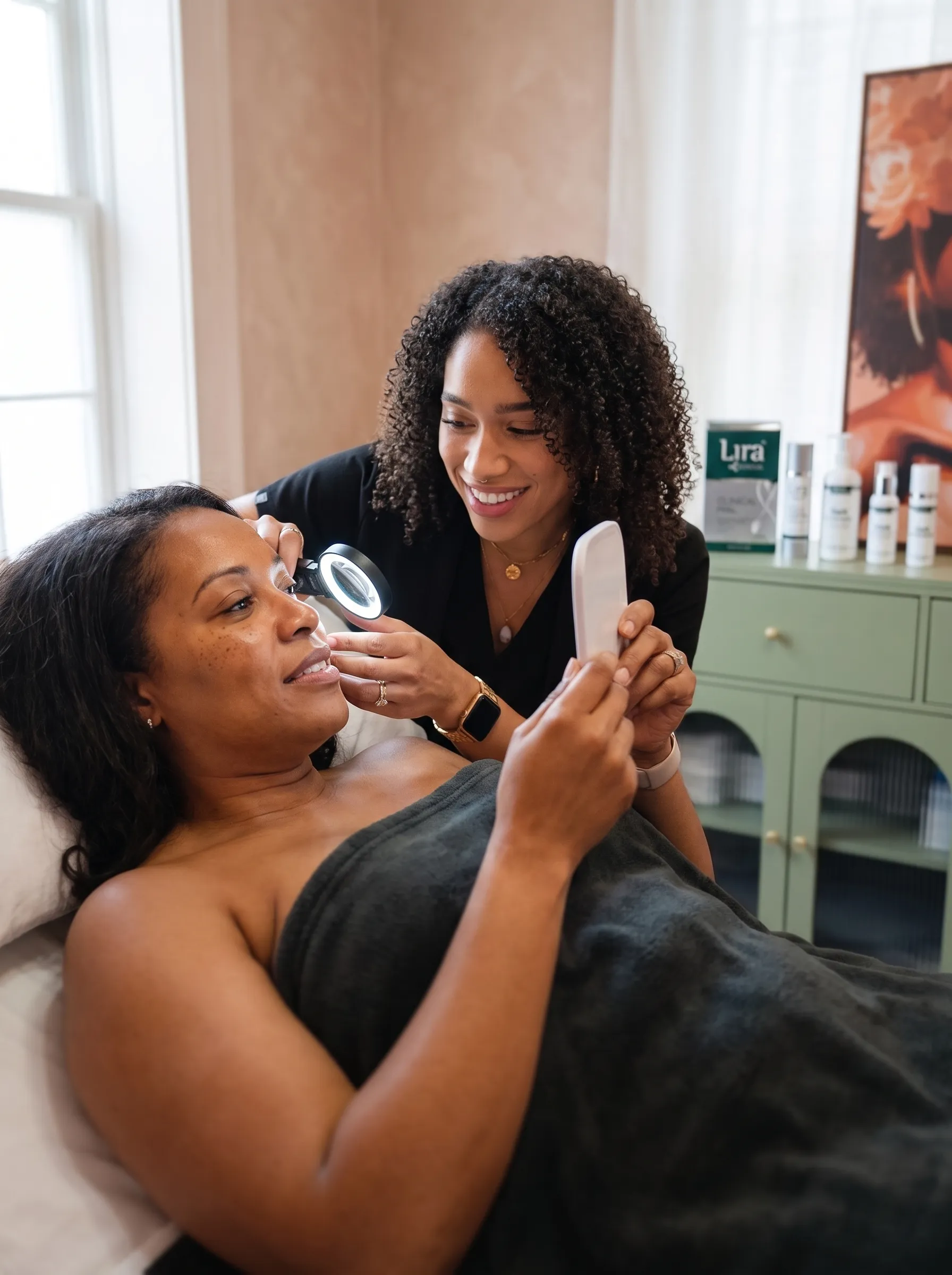
So the first job in the room is separating them. A dark mark that turned up with a breakout and stayed behind is post-inflammatory hyperpigmentation: the skin's response to injury, and the pigment sits where the injury was. Symmetrical darkening across the cheeks that arrived on its own over a summer is melasma. A field of uneven tone across the forehead, nose and cheekbones that has been there for years is sun damage, and it clusters on the highest-exposure areas. They sit in different layers, they respond to different instruments, and a peel built for one applied to another is the single most common reason a correction stalls. The three kinds of dark mark are worth reading before the first appointment rather than after the third.
What the assessment changes for inland skin
Pigmentation does not exist independently of the rest of the skin, and that is where La Mesa differs most from the coastal version of this problem. The air inland is drier, the afternoons are hotter, and a face that has spent years in that climate is frequently dehydrated without looking dry — tight after washing, reactive to a moisturizer that used to be fine, pink for an hour after a hot day. Dehydration does not cause the marks, but it changes how the skin responds to being treated.
This is the practical reason the order of the plan matters. A peel applied to a barrier that is already dehydrated produces an inflammatory response the skin cannot resolve cleanly, and inflammation produces pigment. The correction intended to remove the mark becomes the reason a new one appears. It is also the reason some La Mesa clients begin with DMK enzyme therapy at $279 rather than with a peel, and some begin with a HydraFacial at $259: the one that establishes hydration and tests reactivity before anything stronger is applied.
The assessment also reads depth. Pigment sitting in the surface layer behaves differently from pigment that has descended into the mid-layers over years, and the two are reached differently. That read is what sets the starting strength of the peel and whether Procell microchanneling at $475 needs to be part of the course, since it works mechanically and reaches deeper than a peel does.
How the plan is assembled
The plan is not a package. It is assembled from LIRA chemical peels at $199 for the Gentle Renewal formulation and $299 for the Advanced, and it is built around one rule: the strength escalates across the series, never inside a single visit. The first peel is the conservative one, and the second is calibrated on what the first showed rather than on what a protocol says should come next.
The peel is the standard first step because it reaches the pigment. But it is not the only instrument, and a plan that uses only one instrument is a plan that has been chosen before the skin was looked at. Procell microchanneling at $475, or $1,199 for a series of three, is used where the marks sit alongside texture or scarring — it works mechanically, with no heat and no light, which matters on skin that reacts to both. Dermaplaning at $199 clears the surface buildup that stops a peel from penetrating evenly, which is why it appears in a plan as preparation rather than as an afterthought.
Between the corrective sessions sits the maintenance layer, and it is the piece most clients underestimate. A HydraFacial at $259 is the usual one, with a brightening booster chosen for the pigment rather than a general one. It keeps the barrier hydrated between peels, and it keeps the skin receptive to the next peel.
And then there is the daily work, which is not a treatment at all. Mineral SPF with iron oxides, applied every day, is built into the plan because visible light is a pigment driver in its own right and a UV-only sunscreen does not block it. A tyrosinase inhibitor supports the work between appointments. Without that daily layer, the correction fades and returns — and in La Mesa the exposure that caused the problem is not a season away, it is next Tuesday.
Seasoning the series around the valley heat
Timing is not a scheduling detail here. A peel leaves the skin temporarily more reactive to ultraviolet light, and the protocol requires a stretch of indoor recovery with mineral SPF reapplied through the day. Running that window through a La Mesa summer — when the sky is clear, the afternoons are hot, and the marine layer is not there to soften anything — is the reason some corrections fail before they begin. The series is placed between October and March for that reason, and the recovery days land in a season where staying out of the sun is realistic rather than theoretical.
A client whose work or routine puts them outdoors through the summer is not left without a route. The barrier-first path — enzyme therapy and HydraFacial — carries no sun-avoidance restriction, addresses the condition that is producing the inflammation, and gets a client to the point where a peel can be scheduled safely in autumn. It is slower to start and better suited to a life that does not bend around a recovery window.
What a La Mesa client should expect
The first visit is diagnostic, and the correction that follows is set by what it found. That means the first session may be a peel, and it may not. It may be a HydraFacial establishing a baseline, with the peel series starting a fortnight later once the barrier has been read. Anyone promising a fixed number of sessions before the skin has been examined is guessing at the part that matters.
Recovery is visible. In the days after a peel the skin darkens where the pigment sat, then flakes, then comes up fresher — a sequence that cannot be hidden and does not need to be. Most clients see the first measurable change at around the two-week mark, and the second and third sessions are where the compounding happens. The clinical expectation is reduction rather than elimination: melanocytes keep the capacity to produce pigment for life, so what is being managed is how enthusiastically they respond, not whether they exist.
The plan is written down at the first appointment — how many sessions, how far apart, what to do at home between them — so the schedule is something the client can plan a season around rather than something they negotiate visit by visit.
The eleven miles west
From La Mesa Village on La Mesa Boulevard, take Spring Street west to I-8 westbound, stay on the freeway through Mission Valley past the SR-163 interchange, and exit at Taylor Street or Hotel Circle. The studio is at 3067 Reynard Way in Mission Hills, off Washington Street, with free parking on site. From Grossmont Center, Jackson Drive north reaches the same freeway; from Mt. Helix, Fuerte Drive connects to the Grossmont roads; from Spring Valley, SR-125 north leads to the same interchange.
Off-peak it is fifteen to twenty minutes. Mid-morning and early afternoon are the reliable windows, because the westbound morning commute through Mission Valley is the slow part of the drive and the return trip east can be as bad. From the Spring Street trolley stop the Orange Line runs to downtown and then needs a rideshare from Santa Fe Depot, which is close to double the door-to-door time of driving — workable, but not the way a series gets finished.
The studio is one treatment room, by appointment only, so a space is always there when a client arrive and nobody else is in the room. Every session is performed by Kiki, a California licensed esthetician with 7+ years of experience. Full directions and neighborhood context are on the La Mesa service area page, and an appointment can be requested online or by phone on (310) 595-0872.