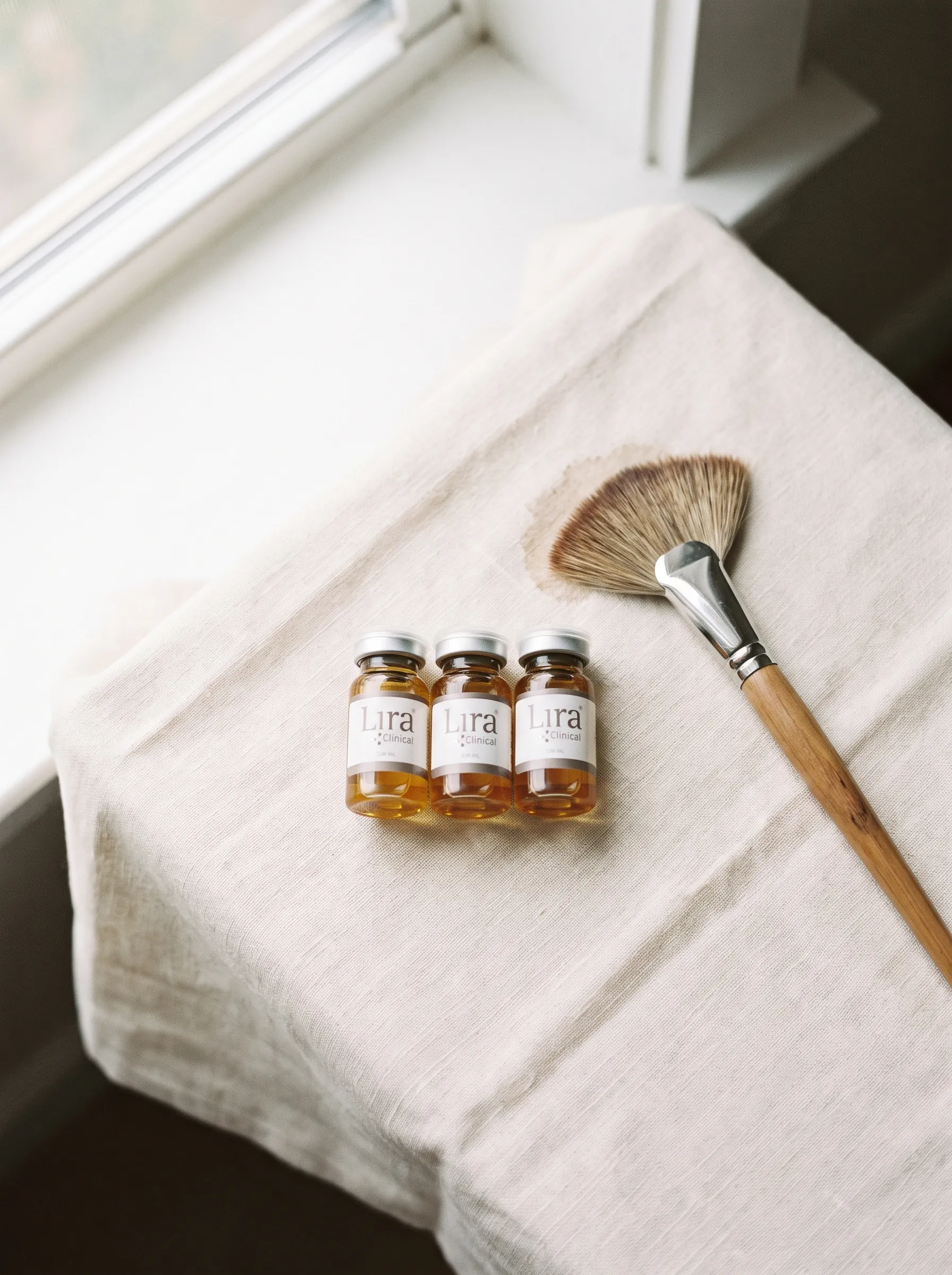
8 min read · Field notes from the treatment room
How to prepare for a chemical peel, and the week before that does the most work
A peel is the treatment, but the week before it is what decides how the skin responds to it. On melanin-rich skin that difference is the difference between clearing pigment and making more of it.
First-time client treatment
$249
- By appointment only
- Free parking
- Free cancellation up to 48 hours before
To prepare for a chemical peel, stop retinoids three to five days before, do not exfoliate or wax the area in the preceding week, start a barrier-supporting routine rather than an active one, and arrive with clean skin. On melanin-rich skin the peel strength is also paced rather than escalated, which is why a series is planned rather than a single session chosen.
Rated 5 out of 5 stars. — 42 five-star Google reviews
- Written by Kiki, licensed esthetician
- Last updated November 21, 2026
- 42 five-star Google reviews
- Prices published before a booking is made
The week before a peel decides how the skin responds to it. Not the week after — that one is about protecting what has been done. The week before is about removing everything that would make the barrier unpredictable on the day.
This matters more than most people expect, and it matters most on melanin-rich skin, where an unpredictable barrier does not just feel worse — it changes how the skin pigments in response.
Why the prep matters more than the peel
A peel works by making the skin react, and then by controlling how it reacts. If the barrier is already compromised by a retinoid, a recent exfoliation or a strong active, the peel has less to work with and the recovery has more to heal. That is why strength is escalated across a series rather than chosen on the first visit, and it is why the home routine in the week before is prescribed rather than improvised.
The studio will tell you what to do before the first appointment, because the answer depends on the treatment and the skin. What follows is the general shape of it, and it is worth checking against the studio instructions rather than instead of them.
What to stop, and when
Retinoids come off first. Tretinoin, Retin-A, adapalene and retinol all increase cell turnover and, used alongside an acid, they accelerate the loss of the barrier far faster than either would alone. The protocol at this studio is three to five days before the peel and five to seven days afterwards.
Isotretinoin is a different category rather than a longer version of the same rule. Peels are not performed during a course of isotretinoin or soon after one, because the skin is rebuilding from nothing while that is happening, and a peel on rebuilding skin is not a controlled reaction.
Everything that physically touches the skin in the week before is also stopped: waxing, threading, dermaplaning at home, and any laser. A peel is applied to a surface, and the surface should be intact and un-inflamed.
Other acids stop too. A brightening serum is usually fine to keep running — it is not an exfoliant — but a second exfoliating acid is a variable the studio would rather not have on the day.
What to bring to the consultation is covered below.
What to start, and what not to
The week before is not the week to try something. It is the week to be boring and consistent: a gentle cleanser, a ceramide-rich moisturiser, and sunscreen every morning.
Nothing new starts in the seven days before. A product that has not been on the skin for a week is a product whose behaviour is unknown, and the point of the assessment is to know how the skin behaves.
Sunscreen is the exception to "nothing new", and it is the one thing worth being strict about. A peel that fades pigment and a routine that lets UV back in are two halves of the same problem.
What happens in the room
The consultation comes first, every time. Skin tone is recorded, the barrier is assessed on the day rather than assumed, and the kind of mark is identified — because post-inflammatory marks, melasma and sun damage look alike and respond in opposite directions.
Then the peel. It is layered and timed to the skin’s response on the day, and strength escalates across a series rather than in a single visit. On a first visit that often means starting gently, which can feel like less than you came for. It is the opposite.
The full protocol is on the chemical peels page, and the way a peel is chosen against microchanneling is covered in peel versus microchanneling.
Afterwards
For 48 hours: nothing. No actives, no exfoliating acids, no retinoid, no sauna, no hot yoga, no long run in the sun, and no other treatments on the same area.
Then the barrier-supporting routine resumes, and the brightening actives come back after the skin has stopped flushing — which is usually a few days, and the studio will tell you when rather than leaving it to a guess.
Daily SPF is what holds the result, and it is the step that gets skipped. Without it the pigment returns, and San Diego overcast mornings are the usual reason people stop applying it.
If a series is planned, the intervals are set at the first appointment and the whole series is scheduled as a block. That is not a scheduling convenience — a peel paced across weeks is doing something different from a peel done as often as the calendar allows.
Where this leaves a client
A first visit is $249 and includes the consultation and skin analysis that turns any of this into a plan for the skin.
Prices are published, the studio is appointment-only, and parking is free.
Written by Kiki, Licensed Esthetician, California Board of Barbering & Cosmetology, with 7+ years treating melanin-rich skin at KIAMO Skin in San Diego.
Common questions
Peel questions
How long before a chemical peel should I stop using retinoids?
Can I wear makeup to my peel appointment?
What should I avoid after a chemical peel?
Why is my first peel gentler than I expected?
How many peels will I need?
Rated 5 out of 5 stars. — 42 five-star Google reviews
“I've been going to KIAMO Skin for over a year and can't recommend it enough. Real, visible results.”
Also in the journal
Three kinds of dark mark, and why one facial cannot fix all three
Choosing a facial for hyperpigmentation before you know which kind you have is the most common reason treatment fails — and occasionally the reason it backfires.
June gloom is not sun protection
The marine layer is the single most expensive misunderstanding in San Diego skincare. It looks like cover. It is not cover.
San Diego hard water and your scalp
If your scalp flakes, itches, or feels coated no matter what shampoo you buy, the shampoo may not be the variable worth changing.
Microneedling on dark skin, and why depth decides the outcome
Not whether needling works on melanin-rich skin, but whether the depth was set correctly for the skin in front of the device.
Is dermaplaning safe for dark skin? Here is what actually matters.
The question is not really whether dermaplaning works on darker skin. It is whether the blade angle and pressure match the skin in front of it.
Professional Scalp Treatment San Diego: Keravive for Dandruff, Flaking & Hair Health
Professional scalp treatment in San Diego. Keravive for dandruff, seborrheic dermatitis, dry scalp and thinning, treating the cause rather than the symptom.
San Diego Scalp Treatments: How Does Keravive Work?
Keravive removes the buildup shampoo cannot reach. Here is what it does, and why San Diego water and sun make it necessary.
Hyperpigmentation Treatment Guide: What Actually Works for Dark Spots, Melasma & PIH
Stubborn dark spots, melasma or uneven tone in San Diego: what actually helps, and why it depends on your skin type.
How much does a chemical peel cost in San Diego?
The price of a chemical peel in San Diego varies by depth and formulation. The more important question is which one your skin needs.
Best chemical peel for melasma, and what the answer actually depends on
Best peel for melasma is a search query, not a clinical answer. Here is the peel your skin type can tolerate every four to six weeks.
Acne scars in San Diego: which ones a facial can fix and which need microneedling
Most of the time when a facial "didn't work" for acne scarring, the scar type was never the issue. The treatment was.
Dermaplaning or a chemical peel: which one actually changes your skin?
These two sound like competing versions of the same thing. One removes what is on top; the other changes what happens underneath.
Best sunscreen for dark spots in San Diego: what to look for on the label
Most sunscreen in San Diego is bought on brand and worn on habit. For a mark that keeps returning, the label matters more than the name.
Chemical peel or microchanneling: which one will clear your dark spots
These two work in opposite directions, one down from the surface and one up from beneath. Choosing wrongly can leave a mark darker.
Best treatment for dark spots on face: which one clears yours, and what each costs
Dark spots have different causes and sit at different depths, so the best treatment only makes sense once you know which one is yours.
Facial for sensitive skin: which modality suits a reactive barrier, and what each one costs
Sensitive skin is not a skin type, it is a condition — and the treatment that calms it can be the treatment that makes it worse.
How much does a facial cost in San Diego in 2026?
The published San Diego market rate for a facial spans a wide range. The gap between the two ends of it is not quality. It is what the price includes. First-time clients here start at $249.
How to fade dark spots at home, and the three things that make them darker
Most home routines for dark marks fail in the same three places, and none of them is the product. The order, the light protection, and what happens in the week after a spot clears.
How to get the most out of a HydraFacial, including what to do the day before
A HydraFacial is a maintenance treatment with a specific job. Doing the day before it right is a short list, and the routine between visits is what decides whether it holds.